Architecturally sensitive homes deserve lighting that works with their character, not against it. Yet many homeowners find themselves wrestling with a patchwork of switches, dimmers, and scenes that never quite deliver the right atmosphere. The result is a home that looks considered but feels clumsy to live in. A structured lighting control workflow changes that entirely. It brings together your circuits, your spaces, and your daily routines into a coherent system, one that respects original features, adapts to every mood, and makes the whole experience of being at home noticeably better.
Table of Contents
- Why a workflow matters for lighting control
- Essential audit: Your property’s lighting baseline
- Designing with layers: Light for every mood and moment
- Step-by-step installation workflow for sensitive homes
- Advanced tips: Overcoming legacy wiring and automation pitfalls
- Comparing platform choices: Wireless vs. wired vs. hybrid options
- Enhance your home: Next steps for elegant lighting control
- Frequently asked questions
Key Takeaways
| Point | Details |
|---|---|
| Start with a clear audit | Mapping circuits and identifying key challenges ensures retrofit success. |
| Layer your lighting | Blending ambient, task, and accent layers gives you flexibility and comfort. |
| Prioritise compatibility and fail-safes | Solutions like smart relays keep homes working, even in legacy wiring scenarios. |
| Choose the right lighting control platform | Wireless is simple, but Zigbee, Thread, and wired systems are best for reliability. |
| Consult professionals early | Professional support protects architectural features and optimises outcomes. |
Why a workflow matters for lighting control
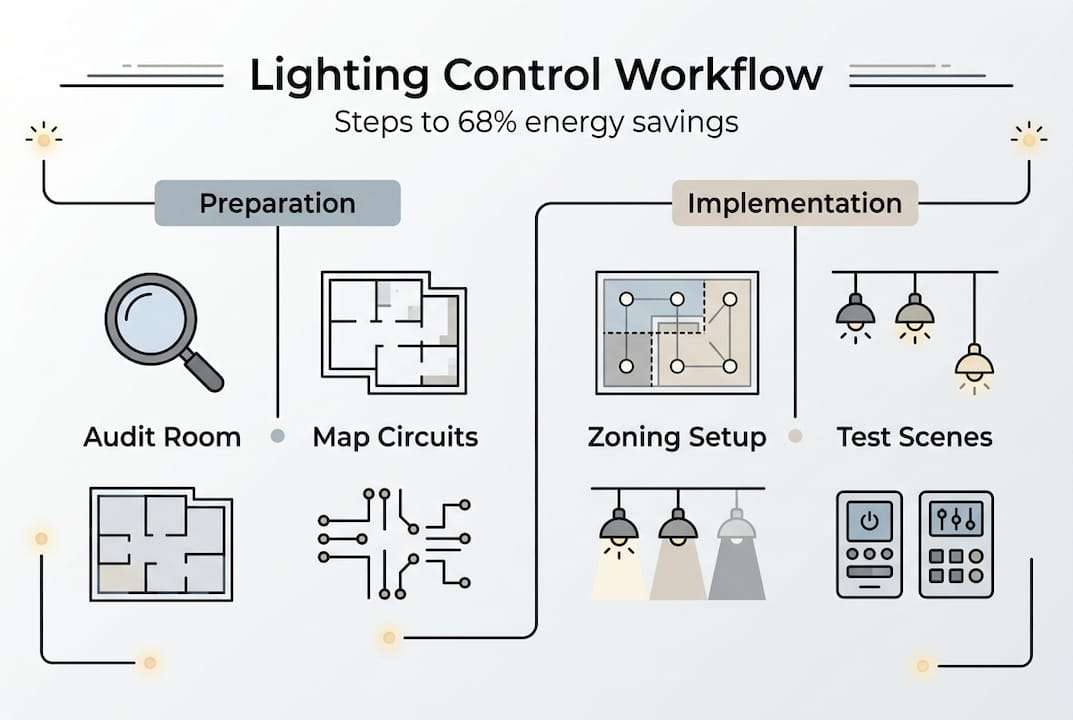
The role of lighting control in a well-designed home goes far beyond switching lights on and off. A workflow, in this context, means approaching your lighting as a system with deliberate stages: audit, design, install, test, and refine. Each stage builds on the last, and the result is a home that responds to how you actually live.
The practical benefits are significant. Energy saving benchmarks show that dimming alone can reduce energy consumption by 50 to 70 percent, with one case study recording a 68% energy reduction and a return on investment within 18 months. Occupancy sensors, when informed by 30 days of usage data before finalising settings, further reduce unnecessary consumption. You can also cut energy use 30% simply by scheduling lights to match your daily patterns.
Beyond energy, circadian lighting, which means adjusting colour temperature and brightness to follow the natural rhythm of daylight, has a measurable effect on sleep quality and general wellbeing. Warmer, dimmer light in the evening signals to your body that the day is winding down. That is a meaningful improvement to daily life, not a technical novelty.
The alternative, adding smart bulbs or switches without a plan, tends to create fragmented lighting control, inconsistent scenes, and frustration. A workflow prevents that.
Top benefits of the workflow approach:
- Consistent, repeatable scenes across every room
- Measurable energy savings from day one
- Lighting that supports sleep, focus, and relaxation
- Preservation of architectural features through considered placement
- A system that grows with your home rather than becoming obsolete
- Reduced reliance on manual adjustment throughout the day
Essential audit: Your property’s lighting baseline
With an understanding of why workflow matters, the next logical step is a systematic audit to uncover opportunities and limits within your home. This is where many homeowners skip ahead, and where most problems begin.
A thorough audit, as outlined in smart house lighting guidance, involves mapping every circuit, checking whether neutral wires are present at each switch position, identifying which fixtures are suitable for retrofit, and selecting priority rooms for a pilot installation. In architecturally sensitive homes, this stage also means noting original cornicing, joinery, and materials that should not be disturbed.
| Finding | Common challenge | Retrofit approach |
|---|---|---|
| No neutral wire at switch | Limits smart switch options | Use relay module or smart bulb |
| Two-way switching | Requires compatible relay | Install smart relay at ceiling rose |
| Decorative pendants | Dimmer compatibility varies | Test with LED driver before committing |
| Recessed heritage fittings | Heat and size constraints | Specify low-profile LED modules |
| Mixed circuit types | Inconsistent lighting control | Zone by room function first |
The seamless ambience guide recommends starting with one room, typically a living room or kitchen, before scaling across the property. This pilot approach lets you test scenes, identify wiring surprises, and refine your preferences without committing the whole house at once.
Pro Tip: Before purchasing any hardware, photograph every switch plate and ceiling rose in your pilot room. Share these images with your lighting designer or installer. It takes ten minutes and can prevent costly mistakes.
Engaging a lighting designer early, ideally before any hardware is ordered, means the UK lighting workflow is shaped around your architecture rather than retrofitted to it.
Designing with layers: Light for every mood and moment
Having mapped your current system, you are ready to craft an experience, starting with a layered approach that brings your architecture to life. Layered lighting is the foundation of any considered scheme, and it is what separates a thoughtfully designed home from one that simply has bright rooms.

The three layers for perfect ambience are ambient, task, and accent. Ambient light provides general illumination. Task light focuses on specific activities such as reading or cooking. Accent light draws attention to architectural features, artwork, or materials. When each layer is controlled independently, you gain genuine flexibility.
| Layer | Purpose | Typical control method |
|---|---|---|
| Ambient | General room illumination | Dimmer, scene controller |
| Task | Focused activity lighting | Localised switch or sensor |
| Accent | Highlighting features or art | Independent dimmer circuit |
As layered lighting tips confirm, independent control of each layer is what allows architecturally sensitive homes to shift from a bright, practical daytime setting to a calm, atmospheric evening scene without touching a single bulb.
For a bespoke lighting scheme, consider the scenes you actually want to achieve:
- Morning: bright ambient with warm task light in the kitchen
- Working from home: focused task light, reduced ambient
- Entertaining: low ambient, accent lights on, no task light
- Relaxing: warm, dim ambient only
- Bedtime: minimal warm light in corridors and bathrooms
Pro Tip: Specify LEDs with a Colour Rendering Index (CRI) above 95 for rooms with natural materials, stone, timber, or plaster. High-CRI light reveals the true colour and texture of these surfaces in a way that standard LEDs simply cannot match. It is one of the most impactful and least discussed choices in lighting design principles.
Step-by-step installation workflow for sensitive homes
Armed with your design, it is time for careful and methodical installation, making sure to preserve both function and the integrity of your property. Rushing this stage is where most avoidable problems occur.
Follow this sequence for a reliable outcome, as detailed in a detailed installation guide:
- Turn off the mains supply to the circuits you are working on. Confirm with a voltage tester before touching any wiring.
- Check for neutral wires at each switch position. Note any locations where they are absent, as these will need a different solution.
- Install hardware in your pilot room first. Fit smart switches, relay modules, or smart bulbs as specified in your design.
- Pair devices to your chosen hub or app. Follow the manufacturer’s sequence carefully, naming each device by room and function.
- Test every scene before moving to the next room. Adjust dimmer levels, colour temperatures, and timing until the result matches your brief.
- Zone and label your system clearly. Organise by room and function so that any member of your household can use it intuitively.
- Scale to the rest of the property only once the pilot room is performing as expected.
Always engage a qualified electrician for any work involving your home’s fixed wiring, particularly in lighting for architecturally designed homes. Disturbing original fabric without proper assessment can cause damage that is both costly and irreversible.
Zoning is worth particular attention. A system organised by room and activity, rather than by circuit number, is far easier to manage and far more satisfying to use day to day.
Advanced tips: Overcoming legacy wiring and automation pitfalls
Even the best-laid plans encounter obstacles. Period homes in particular present challenges that newer builds simply do not have, and knowing how to handle them in advance saves considerable time and expense.
The most common issue is the absence of a neutral wire at the switch position. Many older UK homes were wired without one, which rules out a number of smart switch options. Practical edge case solutions include:
- Relay modules fitted at the ceiling rose, which work with existing switch wiring
- Smart bulb retrofits, which move the intelligence to the fitting rather than the switch
- No-neutral smart switches, which draw a small trickle current and work with compatible dimmers
- Fail-safe manual switches wired in parallel, so the lights always work even if the smart system is offline
- Multi-way switching resolved with smart relays rather than replacing all switch positions
Automation reliability is another area that deserves careful thought. A common frustration is lights that flicker on and off because a single motion sensor is triggering repeatedly, a problem sometimes called flapping. The solution is to combine multiple sensor inputs, for example motion plus lux level, so that the system only acts when both conditions are met. This approach, drawn from smart house lighting practice, produces far more stable and predictable behaviour.
Always test your fail-safes. Manual switches should operate the lights independently of any hub, app, or internet connection. This is not a secondary concern. It is a fundamental part of a well-designed workflow for effortless home ambience.
Comparing platform choices: Wireless vs. wired vs. hybrid options
Selecting the right platform is essential for reliability, particularly in larger or more complex homes. The choice you make here affects how your system performs for years to come.
As smart lighting systems compared shows, each platform type has genuine trade-offs:
| Platform | Reliability | Complexity | Best suited to |
|---|---|---|---|
| Wi-Fi bulbs | Cloud-dependent, can be fragile | Low | Small homes, single rooms |
| Zigbee or Thread with bridge | Local-first, robust at scale | Medium | Larger homes, Philips Hue, Lutron |
| Wired centralised system | Highest precision and reliability | High | Complex or period properties |
| Hybrid wired and wireless | Flexible and future-proof | Medium to high | Architect-led homes with mixed needs |
Wi-Fi bulbs are straightforward to install but scale poorly. When you have thirty or forty devices, cloud dependency becomes a real vulnerability. Zigbee and Thread protocols, used by systems such as Philips Hue and Lutron, operate locally within your home, meaning they continue to function even if your internet connection drops. Wired centralised systems, such as those from Control4 or Lutron RadioRA, offer the greatest precision and are well suited to properties where reliability is non-negotiable.
Pro Tip: Before committing to a platform, test your chosen scenes in a single room for at least two weeks. Live with the system through different times of day and different household routines. What works in a showroom does not always translate to daily life.
For innovative solutions for architect homes, a hybrid approach, combining a wired backbone with wireless flexibility in secondary spaces, often delivers the best balance of performance and adaptability.
Enhance your home: Next steps for elegant lighting control
A well-structured workflow transforms lighting from a background consideration into one of the most noticeable improvements you can make to your home. The process, from audit through to commissioning, is straightforward when approached methodically and supported by the right expertise.
At Morgan Wrona, we work with homeowners and their design teams to develop lighting automation services that are genuinely tailored to each property. Whether you are beginning an audit, refining an existing system, or planning a full installation, our team brings the experience to guide you through every stage. Explore the benefits of automated lighting for architect-led homes, or begin with our lighting workflow consultancy to map out the right approach for your property. If you would like to discuss how this could work in your home, contact us or call [01793 315930](tel:01793 315930).
Frequently asked questions
What if my home doesn’t have neutral wires in every switch?
You can use relay modules or smart bulb retrofits, but always consult a professional before proceeding in a heritage or listed property to avoid damage to original fabric.
How much energy could I realistically save with a modern lighting control workflow?
Case studies show potential energy savings of up to 68 percent, with an average payback period of around 18 months when dimming and occupancy control are combined.
How do I select the right control platform for a complex or period property?
Larger and older homes generally benefit from Zigbee, Thread, or wired solutions because they operate locally and maintain reliability without depending on a cloud connection.
Is it possible to keep manual operation in case of tech issues or power outages?
Yes. A properly designed system includes manual override switches wired in parallel, so lights remain fully operable even when the smart system or internet connection is unavailable.
How do I avoid over-automation or accidental disruptions to ambience?
Combine motion and lux sensors so the system only responds when both conditions are met, and test every scene with all household members before finalising settings.