TL;DR:
- A well-designed home cinema can be seamlessly integrated into architecturally styled spaces.
- Careful planning, coordination, and equipment selection ensure optimal performance and aesthetic harmony.
- Collaboration between homeowners, architects, and specialists is essential for a tailored, unobtrusive experience.
Homeowners with architect-designed properties often face a particular tension: you want the cinematic experience, but not at the cost of the spaces you have carefully created. A projector bolted to a ceiling or a tower of black equipment in the corner can feel like a compromise too far. The good news is that it does not have to be that way. A well-planned home cinema, designed from the outset with your architecture in mind, can sit invisibly within your home while delivering a genuinely immersive viewing experience. This guide walks you through every stage, from defining your goals to installation and aftercare, so you can move forward with clarity and confidence.
Table of Contents
- Understanding your home cinema goals
- Planning and preparing your space
- Choosing the right equipment and design features
- Installation best practices and common pitfalls
- Our perspective: what truly sets a bespoke home cinema apart
- Unlock your dream home cinema with expert integration
- Frequently asked questions
Key Takeaways
| Point | Details |
|---|---|
| Tailored planning is crucial | Define clear goals with your architect and installer for a cinema that fits both use and aesthetic needs. |
| Integration ensures seamless design | Coordinate your cinema with lighting, acoustics, and architecture for a unified look and function. |
| Tech choices drive experience | Choose equipment not just for specs, but for how it fits the room and enhances daily enjoyment. |
| Expert installation avoids common pitfalls | Engage professionals to handle cabling, calibration, and safety for lasting performance. |
Understanding your home cinema goals
Before any equipment is specified or cables are routed, the most valuable thing you can do is define what you actually want from your home cinema. This sounds straightforward, but it is where many projects lose their way. Without a clear brief, decisions get made on the fly, and the result rarely feels as considered as it should.
Start by thinking about how you will use the space most often. The answers shape everything that follows.
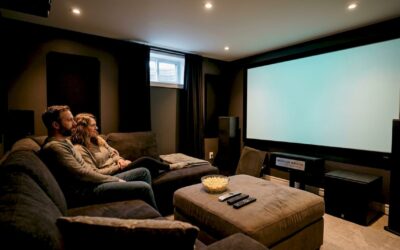
- Film nights with family or friends: You will want comfortable seating for several people, excellent surround sound, and a large, high-quality image.
- Sport and live events: Fast-moving content benefits from high-refresh-rate displays and clear, dynamic audio rather than purely cinematic acoustics.
- Gaming: Low input lag, responsive displays, and immersive audio matter here, alongside ergonomic seating.
- Entertaining guests: You may want the room to function as a social space too, which influences how equipment is concealed and how lighting is controlled.
Your design intent should drive your technology choices, not the other way around. If your home has a particular architectural character, whether that is a clean-lined contemporary interior or a more traditional aesthetic, the equipment and its installation need to respect that. Hidden in-wall speakers, flush-mounted screens, and carefully routed cabling all serve the architecture rather than fighting it. Creating a tailored experience from the start means fewer compromises later.
Upfront planning also protects your investment. A well-designed home cinema can boost property value while providing tailored entertainment, but only when the integration is thoughtful and the finish is considered.
Balancing the wow factor with day-to-day comfort is equally important. A room that feels spectacular on opening night but is awkward to use daily will simply go unused. Think about ease of control, ambient lighting for casual viewing, and whether the space needs to serve other purposes during the day.
Pro Tip: Write down your three most common viewing scenarios before your first consultation. This single exercise helps your installer specify the right system rather than the most impressive one.
Planning and preparing your space
With clear goals established, the next stage is understanding the physical realities of your space. This is where technical planning and architectural coordination come together, and where early attention to detail pays dividends throughout the project.
A thorough site survey is the starting point. Key factors to assess include:
- Room dimensions and geometry: Width, length, and ceiling height all affect speaker placement, screen size, and acoustic behaviour.
- Natural light and windows: Light entering the room at certain times of day can wash out a projected image. Blackout solutions need to be planned architecturally, not added as an afterthought.
- Ventilation and thermal management: AV equipment generates heat. Adequate ventilation for equipment racks is essential, both for performance and longevity.
- Structural elements: Beams, columns, and load-bearing walls affect where speakers, screens, and cabling can be positioned.
- Service routes: Power, data, and signal cables need a clear path from source to destination without compromising the fabric of the building.
“Careful coordination with architects and contractors is vital to achieve an integrated finish and optimal acoustic environment.”
Working directly from architectural drawings allows your installer to identify potential conflicts early, before walls are closed or finishes are applied. This is particularly important in new builds or significant renovations, where the cinema can be fully integrated into the structure. In existing homes, careful planning of service routes and equipment locations minimises disruption and avoids visible conduit or surface-mounted cabling.

| Planning factor | Why it matters | How to address it |
|---|---|---|
| Room dimensions | Affects screen size and speaker layout | Survey early, model acoustically |
| Natural light | Can reduce image quality | Specify architectural blackout |
| Ventilation | Equipment overheating reduces lifespan | Plan dedicated rack ventilation |
| Power supply | Insufficient circuits cause failures | Dedicate circuits during first fix |
| Network infrastructure | Streaming and control depend on it | Install structured cabling at build stage |
Lighting integration with architectural planning is another area that benefits from early coordination. Lighting circuits, dimmer positions, and scene control need to be considered alongside the cinema design, not separately. A workflow for seamless ambience ensures that your cinema lighting behaves as part of the whole home, not as a standalone system. Following CEDIA’s installation standards provides a reliable framework for quality and consistency throughout the project.
Choosing the right equipment and design features
Once the space is understood and the plans are coordinated, equipment selection becomes a much clearer process. The goal is to match performance to the room and the architecture, rather than to a specification sheet.
Display options: projectors versus OLED screens
| Feature | Projector | OLED screen |
|---|---|---|
| Image size | Very large, scalable | Fixed, typically up to 97 inches |
| Room light sensitivity | Requires controlled light | Performs well in ambient light |
| Design integration | Screen can retract flush | Wall-mounted, slim profile |
| Maintenance | Lamp or laser replacement | Minimal |
| Best suited to | Dedicated cinema rooms | Multi-purpose living spaces |
For dedicated rooms, a projector with a retractable screen offers a genuinely cinematic scale. In multi-purpose spaces, a large-format OLED provides excellent image quality without requiring blackout conditions.
Audio: in-wall, in-ceiling, or freestanding?
In-wall and in-ceiling speakers disappear into the architecture entirely. They require careful placement and correct installation to perform well, but the result is a room that looks like a room, not an equipment showroom. Dolby Atmos, a format that places sound above and around you for a three-dimensional effect, works particularly well with ceiling-mounted speakers in a designed space.
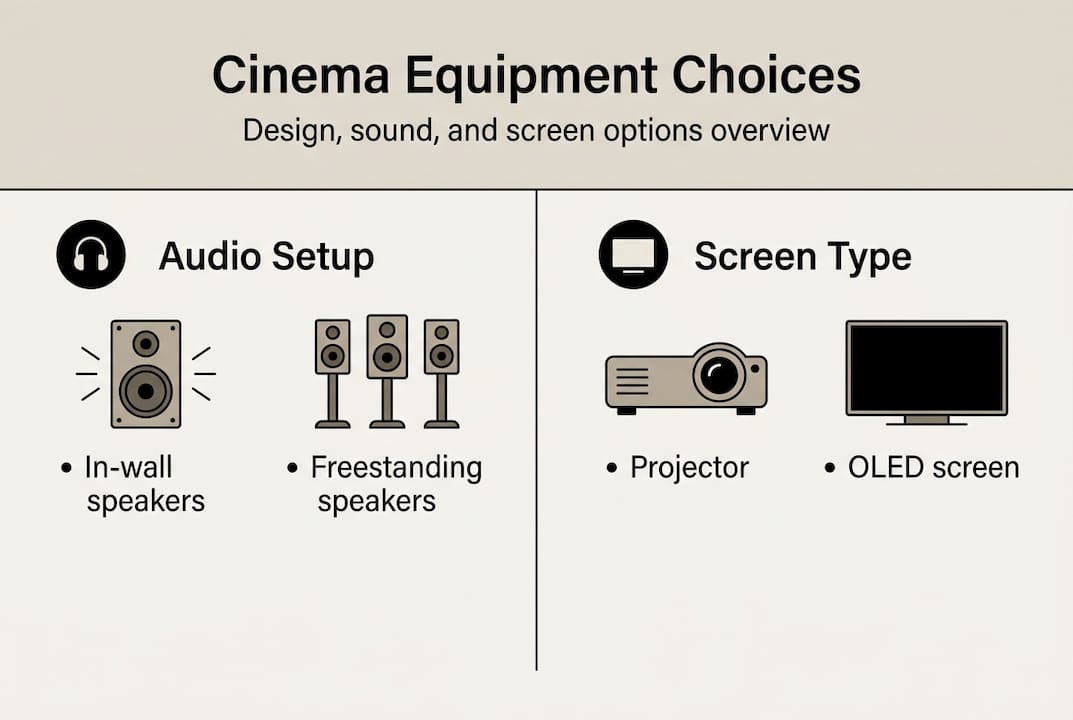
Advanced home cinema systems now offer fully hidden speakers, ultra-short-throw projectors, and lighting scenes that adapt to viewing modes, giving you the performance without the visual clutter.
Key design features to consider:
- Lighting control: Scenes that dim automatically when playback begins, with a gentle warm glow for interval breaks, make the experience feel effortless. Read more about lighting’s impact on cinema experience.
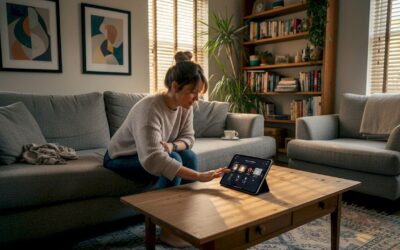
- Control systems: A single app, a dedicated remote, or voice control can manage the entire room. The best systems are intuitive enough that every member of the household uses them without instruction.
- Acoustic treatment: Panels, diffusers, and soft furnishings all affect how sound behaves in the room. These can be integrated into the interior design rather than applied as visible acoustic foam. For further guidance, expert home cinema design covers these considerations in depth.
Installation best practices and common pitfalls
Even the best-specified system can underperform if installation is handled without care. These are the practices that separate a system that works from one that truly delivers.
- Structured cabling first: All signal, power, and network cables should be installed before walls are closed. Retrofitting cables through finished walls is disruptive and costly.
- Speaker positioning: Placement should follow the room’s acoustic model, not convenience. Incorrect positioning is one of the most common causes of poor sound in otherwise well-specified systems.
- DSP calibration: A digital signal processor (DSP) adjusts the audio output to suit the specific acoustic characteristics of the room. This step should always be carried out by a qualified engineer using measurement equipment, not by ear alone.
- Rack ventilation: Equipment racks must have adequate airflow. Overheating shortens the lifespan of components and causes unexpected shutdowns.
- Access for maintenance: Panels, access hatches, and removable sections should be planned into the installation so that future servicing does not require destructive work.
“Professional installation ensures perfect cable management, proper calibration, and long-term reliability.”
Common mistakes worth avoiding include sound leakage into adjacent rooms, which requires acoustic isolation in the walls, floor, and ceiling. Light pollution from gaps around doors or ventilation grilles can ruin the viewing experience and is easily addressed at installation stage. Incompatible equipment is another frequent issue: not all components communicate well together, and specifying a system as a whole, rather than assembling it piecemeal, avoids this entirely.
Pro Tip: Ask your installer to walk you through the calibration process after commissioning. Understanding what has been set up, and why, means you can use the system confidently and report any changes accurately if support is ever needed.
Fire safety and building regulations should be observed throughout. Cable routes through fire compartments require appropriate fire-stopping, and your installer should be familiar with the relevant requirements. For further reference, design principles for home cinemas offer a useful overview of considered installation practice. Ongoing lighting control for cinemas and architectural impact of automation are worth reviewing as part of your broader system planning.
Our perspective: what truly sets a bespoke home cinema apart
After working on many architect-designed homes, we have noticed a consistent pattern. The projects that genuinely delight their owners are rarely the ones with the most impressive specifications. They are the ones where the system has been thought through as part of the home, not installed into it.
Technology is a means to an end. The end is an experience that feels natural, that every member of the household can operate without thinking, and that fits the rhythm of daily life. A cinema that requires a manual to use, or that looks out of place in a beautifully designed room, has missed the point regardless of its component quality.
The collaboration between homeowner, architect, and installer is where the real work happens. When those three parties share information early and often, the result is a system that is invisible when it should be and spectacular when it matters. Design-led cinema concepts reinforce this thinking: the architecture and the technology should serve each other.
Aftercare matters too. A system that is well-supported over time, with a team who knows your installation, gives you confidence that it will continue to perform as your needs evolve.
Unlock your dream home cinema with expert integration
If this guide has helped clarify what is involved, the next step is a conversation with a specialist who can apply this thinking to your specific home and brief.
At Morgan Wrona, we work closely with homeowners and their architects to design and install home cinema systems that respect the integrity of the spaces they sit within. From initial consultation through to commissioning and aftercare, every stage is managed with care. Explore our approach to home cinema automation impact and our integrated home cinema service to understand how we work. If you would like to discuss your project, contact us or call [01793 315930](tel:01793 315930).
Frequently asked questions
How long does a typical home cinema installation take?
Project durations vary from two weeks for straightforward installations to several months for complex new builds, depending on site readiness and system scope.
Can home cinema be installed in a multi-purpose room?
Yes. With the right technology choices, cinema features can be designed to disappear when not in use, allowing the room to function as a lounge or living space at other times.
What is the approximate cost range for a home cinema?
Bespoke home cinemas in design-led homes typically range from £15,000 to well over £100,000, depending on the equipment specified and the degree of custom integration required.
Can automation and lighting be integrated with my cinema setup?
Modern systems allow lighting, blinds, and control to be fully integrated so that a single action sets the room for viewing, adjusting every element simultaneously without manual intervention.