TL;DR:
- Smart lighting enhances homes by responding to natural light, occupancy, and daily routines.
- Properly integrated systems reduce energy use, increase property value, and improve daily comfort.
- Professional design and installation are crucial to avoid technical issues and ensure seamless operation.
A beautifully designed home can still feel frustrating to live in. Spaces that look extraordinary in photographs sometimes fall short in everyday use, particularly when lighting has been treated as an afterthought rather than a considered element of the design. Intelligent lighting addresses this gap directly, adapting to how you actually live rather than how a space was imagined on paper. This guide explores what smart lighting genuinely means for architecturally designed UK homes, the practical benefits it delivers, its impact on energy use and property value, and how to implement it without the common pitfalls that undermine even well-intentioned installations.
Table of Contents
- What does smart lighting mean for homes?
- How smart lighting transforms daily living
- Smart lighting and home value: energy, efficiency, and future-proofing
- Choosing and implementing the right smart lighting for your home
- What most guides miss about smart lighting in architect homes
- Transform your home with expert smart lighting solutions
- Frequently asked questions
Key Takeaways
| Point | Details |
|---|---|
| Clarity on smart lighting | Smart lighting means more than remote bulbs—it adapts spaces to daily life and architecture. |
| Lifestyle and wellbeing boost | Intelligent controls improve routines, comfort, and even health by supporting natural rhythms. |
| Energy and property value | Automated systems can dramatically reduce bills and make high-end homes even more attractive. |
| Avoiding common pitfalls | Expert planning is essential to avoid issues like WiFi congestion and missed design potential. |
| Expert support matters most | Professional implementation ensures smart lighting works beautifully in unique homes for years to come. |
What does smart lighting mean for homes?
Smart lighting is often misunderstood. Many homeowners assume it simply means controlling bulbs from a phone app. In reality, it is a far more considered system that integrates automation, sensors, and adaptive controls to shape how a space feels and functions throughout the day.
For architect home lighting design, smart lighting works in harmony with the architectural intent of a space. It responds to natural daylight, adjusts to occupancy, and allows you to set scenes for different moments, whether that is a quiet evening, a dinner gathering, or a working morning. The system learns the rhythms of your home and responds accordingly.
Core features of a well-designed smart lighting system include:
- Scene setting: Pre-programmed lighting states that shift the mood of a room with a single action
- Daylight harvesting: Sensors that measure natural light and adjust artificial lighting to maintain consistent illumination
- Energy monitoring: Real-time data on consumption, helping you understand and reduce usage
- Occupancy detection: Lights that activate and deactivate based on presence, removing the need to think about switches
- Dimming control: Graduated output that supports both task lighting and relaxed ambience
To enhance a UK architect home, these features must work together seamlessly. A system that does only one of these things well is not truly smart.
It is worth noting that contrasting views on energy savings exist: while sensor-driven and daylight-integrated systems deliver meaningful efficiency gains, poor implementation, such as overloading a WiFi network or installing systems without dimming capability, can negate those benefits entirely.
Smart lighting is not a product. It is a considered approach to how a home is experienced.
How smart lighting transforms daily living
Understanding what smart lighting is only becomes meaningful when you see how it changes the texture of daily life. The impact is felt in small, consistent ways that accumulate into a genuinely different experience of your home.
Here are the key areas where the transformation is most tangible:
- Supporting natural rhythms: Lighting that shifts from cooler, energising tones in the morning to warmer, calmer tones in the evening supports your body’s natural circadian rhythm, aiding sleep quality and reducing fatigue.
- Hands-free pathways: Sensors activate lighting along corridors and staircases at night, removing the need to fumble for switches and improving safety without interrupting rest.
- Event and occasion scenes: A single preset can shift your living room from a bright, functional space to a warm, relaxed setting for an evening with guests.
- Security integration: Lighting can be linked to security systems, simulating occupancy when you are away or responding to motion detection at entry points.
- Privacy and comfort: Automated blinds and lighting work together to manage glare, maintain privacy, and create comfort throughout the day.
Pro Tip: When planning scenes, think about the five or six moments in your day that matter most, morning coffee, working from home, cooking, entertaining, winding down, and build your lighting programme around those. Fewer, well-considered scenes work far better than a complex library of options you rarely use.
The ability to transform your home experience through lighting is well supported by research, though it comes with an important caveat. Energy savings and human-centric lighting risks are real: human-centric lighting, when not carefully implemented, can increase rather than decrease energy consumption. This is why the design of the system matters as much as the technology itself.
For lighting control in daily living, the goal is always simplicity. A system that requires constant management is one that will eventually be abandoned. The best installations are the ones you stop noticing because they simply work.

Smart lighting and home value: energy, efficiency, and future-proofing
Beyond comfort, smart lighting has a measurable impact on energy consumption and long-term property appeal. For homeowners considering the full return on their investment, these figures are worth understanding clearly.
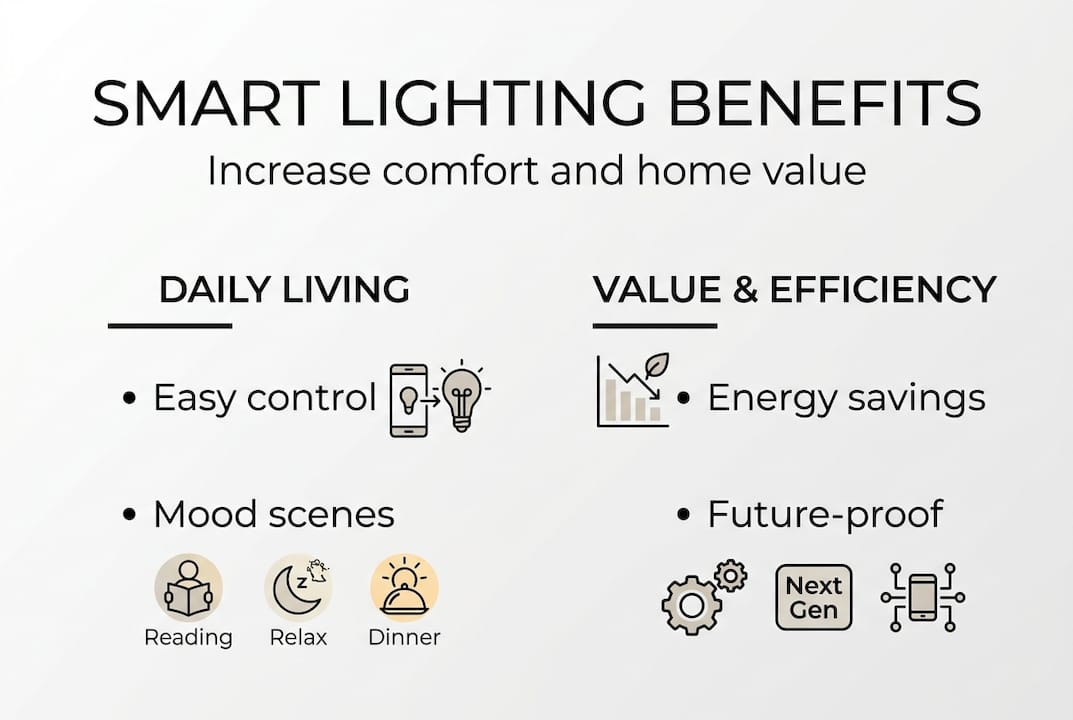
| Feature | Traditional lighting | Smart lighting |
|---|---|---|
| Energy consumption | Fixed, often inefficient | Reduced through sensors and dimming |
| Daylight integration | None | Automated harvesting |
| Occupancy response | Manual switching | Sensor-activated |
| Energy monitoring | Not available | Real-time data |
| Property appeal | Standard | Increasingly expected by buyers |
| Long-term adaptability | Limited | Scalable and upgradeable |
Energy savings with robust sensors and daylight harvesting are significant, but improper setup can negate these benefits. A system installed without proper dimming capability or one that overloads the home network will consume more energy than it saves.
For homeowners looking to reduce energy use, the key is specification. The technology alone does not deliver savings; the way it is designed and commissioned does.
The property value argument is equally compelling. Buyers of architecturally designed homes increasingly expect integrated systems as part of the fabric of the property. A well-documented, professionally installed smart lighting system signals that a home has been cared for thoughtfully.
Avoid these common pitfalls that undermine efficiency:
- Installing smart bulbs on circuits without dimmer compatibility
- Connecting too many devices to a single WiFi band, causing dropouts
- Choosing systems that cannot be expanded as your needs evolve
- Overlooking commissioning and scene programming after installation
Our energy saving guide covers the practical steps to avoid these issues and ensure your system performs as intended from day one.
Choosing and implementing the right smart lighting for your home
With a clear understanding of the benefits and risks, the practical question becomes: how do you select and implement a system that genuinely suits your home?
The first consideration is compatibility with your home’s architecture and existing infrastructure. A Georgian townhouse and a contemporary open-plan extension have very different lighting requirements, and the system must be specified accordingly.
| Approach | DIY installation | Professional installation |
|---|---|---|
| Design input | Limited | Full architectural integration |
| Commissioning | Self-managed | Expert-led and tested |
| Scalability | Often restricted | Designed to grow |
| Support | Manufacturer only | Ongoing aftercare |
| Risk of pitfalls | Higher | Significantly reduced |
Follow these steps to implement smart lighting effectively:
- Assess your home’s needs: Identify the spaces and daily routines where lighting has the most impact.
- Consult a specialist: Engage someone who understands both architectural intent and system design before specifying any equipment.
- Specify for your network: Ensure your home’s WiFi infrastructure can support the system without overload. Wired protocols such as KNX or systems like Lutron RadioRA offer greater reliability than WiFi-only solutions.
- Prioritise dimming: Every circuit should support graduated dimming. This is foundational, not optional.
- Commission carefully: Programming scenes and testing the system thoroughly before handover is where good installations are distinguished from average ones.
- Plan for aftercare: A system that cannot be updated or adjusted over time will become a source of frustration.
Pro Tip: Pitfalls of poor implementation, including WiFi overload and the absence of dimming options, are among the most common reasons smart lighting systems underperform. Addressing these at the specification stage costs far less than correcting them afterwards.
Our lighting integration steps and seamless ambience guide offer structured support for each stage of this process.
What most guides miss about smart lighting in architect homes
Most articles on smart lighting focus on features and savings. What they rarely address is the lived experience of owning and operating these systems over time.
The truth is that many homeowners who invest in smart lighting find themselves frustrated within the first year, not because the technology failed, but because the system was designed around a product catalogue rather than around how they actually live. Scenes that seemed logical during installation feel arbitrary in practice. Controls that appeared intuitive become a source of daily friction.
Architecturally designed homes require a different approach. The lighting must disappear into the fabric of the space. When it works well, you are not aware of it. You simply feel comfortable, at ease, and at home.
This is why collaboration matters more than specification. The conversation between a lighting designer, an integrator, and the homeowner is where the real work happens. The technology is secondary to that understanding.
We have seen how smart lighting shapes living spaces when it is designed with genuine care for how a home is used. The result is never about features. It is about a home that feels right, every day, without effort.
Focus on simplicity, reliability, and the ability to adapt over time. Those three qualities will serve you far better than any list of technical capabilities.
Transform your home with expert smart lighting solutions
If this article has helped clarify what smart lighting can genuinely offer your home, the next step is a conversation rather than a purchase decision.
At Morgan Wrona, we work with homeowners and their design teams to create integrated lighting solutions that serve the architecture and the people within it. From initial consultation through to commissioning and aftercare, every stage is handled with care and precision. Whether you are planning a new build, a renovation, or simply want to improve how your current home feels, we are here to help. Explore lighting automation expertise and lighting control for modern homes on our website, or call us on [01793 315930](tel:01793 315930) to begin the conversation.
Frequently asked questions
Can smart lighting really lower my energy bills?
Yes. When properly installed with sensors and daylight harvesting, energy savings are significant, with well-specified systems achieving reductions of up to 68% compared to conventional setups.
How do I avoid technical problems like WiFi overload in my smart lighting setup?
Work with experienced professionals and choose systems that scale reliably. Poor implementation including WiFi overload is one of the most common reasons smart lighting underperforms, and it is entirely avoidable with the right specification from the outset.
Is smart lighting worth it for period or architecturally unique homes?
Absolutely. Smart systems can be tailored to complement unique architecture sensitively, enhancing both the experience of the space and its long-term property value without compromising the design.
Will smart lighting work if I am not tech-savvy?
Modern smart lighting is designed to be intuitive. With well-programmed scenes and straightforward controls, daily use requires no technical knowledge whatsoever.