TL;DR:
- Smart lighting in 2026 focuses on adaptability and integrated control rather than just energy savings. Layered lighting design and relay-based systems provide reliability and seamless integration with other home functions. The primary benefit lies in enhancing daily comfort, wellbeing, and architectural coherence through personalized and automated scenes.
Smart lighting is often sold on the promise of lower electricity bills. It is a reasonable expectation, but most value comes from the experience itself rather than the savings column. The real shift in 2026 is about how your home responds to you: the way a room transitions from a bright working environment to a calm evening retreat, the way scenes adjust automatically as your day unfolds. For homeowners with architect-designed properties, this adaptability is where intelligent lighting earns its place. This article explores what smart lighting genuinely delivers, what to watch out for, and how to plan a scheme that works with your home rather than against it.
Table of Contents
- What makes smart lighting different in 2026?
- Beyond energy savings: experience, lifestyle, and control
- Key considerations in smart lighting design
- How to maximise smart lighting benefits in your home
- What most guides get wrong about smart lighting
- Discover advanced home lighting solutions
- Frequently asked questions
Key Takeaways
| Point | Details |
|---|---|
| Flexible over frugal | The greatest benefit of smart lighting is daily adaptability and convenience, not raw energy cost savings. |
| Layered design matters | Carefully planned, layered smart lighting provides more comfort, zones, and customisation for architect-led homes. |
| Choose relays, not bulbs | For whole-home systems, relays offer greater reliability, central integration, and better control than smart bulbs. |
| Efficiency versus experience | Actual energy savings are modest and may be outweighed by improved comfort, so prioritise feature-rich solutions. |
What makes smart lighting different in 2026?
Smart lighting has been available for well over a decade, but the systems available today are meaningfully different from their predecessors. Earlier generations relied on individual smart bulbs connected to a basic app. Today, the best systems integrate with whole-home automation platforms, respond to occupancy, time of day, and even natural light levels, and allow you to create layered environments that feel considered rather than programmed.
The concept of three-layer lighting design is central to this shift. The three layers are ambient (general fill light), task (focused, functional light), and accent (decorative or architectural highlights). When all three are controlled intelligently and independently, a single room can serve multiple purposes without any manual adjustment. That is a meaningful change for how you actually live in a space.
“Layered lighting design is key to adaptability, not just gadgets.” This distinction matters because it moves the conversation away from technology for its own sake and towards spaces that genuinely respond to need.
In 2026, the latest lighting trends for architect-led homes reflect this maturity. Designers are specifying systems that integrate with blinds, heating, and audio, creating environments that shift cohesively. A morning routine might raise the blinds, bring the lights to a cool, energising tone, and set the kitchen to full brightness, all triggered by a single action or a set time.
Key advances that define today’s systems:
- Responsive controls: Scenes that adjust based on occupancy, time, or natural light rather than manual switching
- Integration depth: Lighting that works alongside blinds, heating, and security within a single interface
- Reliable infrastructure: Relay-based systems and mesh networks that reduce the instability of earlier WiFi-dependent setups
- Architectural sensitivity: Fixtures and controls designed to complement rather than interrupt the visual language of a space
The result is a system that becomes invisible in the best possible sense. You stop thinking about the lighting because it simply does what you need it to do.
Beyond energy savings: experience, lifestyle, and control
While technical innovation is essential, it is the shift in benefits that truly matters to daily living. Energy savings from smart lighting are real, but modest. Research suggests the saving per lamp sits at roughly £6 to £15 per year, and the lighting rebound effect often reduces even that figure. The rebound effect describes what happens when efficiency improvements lead people to use lighting more freely. Better light quality encourages longer use, which offsets a portion of the efficiency gain.
A BBC lighting analysis noted that the payback period for smart lighting systems can stretch considerably when energy savings alone are used to justify the investment. This is not a reason to avoid smart lighting. It is a reason to invest in it for the right reasons.
| Benefit | What it delivers | Relative impact |
|---|---|---|
| Energy saving | £6 to £15 per lamp per year | Low to moderate |
| Personalised scenes | Tailored ambience for each room and routine | High |
| Automated routines | Lighting adjusts without manual input | High |
| Comfort and wellbeing | Better sleep, focus, and mood through tunable light | High |
| Architectural coherence | Lighting that enhances the design intent of the space | Very high |
For architect-designed homes, the most meaningful gains come from personalisation and adaptability. Consider what it means to have a home that adjusts its atmosphere as your needs change throughout the day:
- Morning scenes that ease you into alertness with warm, gradually brightening light
- Working hours with task-focused, cooler tones that support concentration
- Evening settings that shift to warmer, lower levels as the household winds down
- Night modes that allow safe movement without disturbing sleep
These automated lighting benefits are felt daily. They reduce friction, support wellbeing, and make a home feel genuinely responsive.
Pro Tip: When planning your system, prioritise the scenes and routines you will actually use over marginal energy savings. A system designed around your daily patterns will deliver far more satisfaction than one optimised purely for wattage reduction.
Key considerations in smart lighting design
Understanding design priorities leads directly to the practical challenges and choices homeowners face. One of the most consequential decisions is whether to use relay-based systems or smart bulbs.
Relay vs. smart bulbs: a clear comparison
| Factor | Relay-based system | Smart bulbs |
|---|---|---|
| Reliability | High, works with standard switches | Variable, dependent on WiFi or hub |
| Integration | Seamless with central control systems | Limited, often app-dependent |
| Aesthetics | No visible change to fixtures | Bulb must be visible and compatible |
| Standby draw | Minimal per relay | Can accumulate across many bulbs |
| Scalability | Straightforward to expand | Can create network congestion |
As planning guidance confirms, relays outperform smart bulbs for reliability and are the preferred approach for mains lighting in whole-home schemes. Smart bulbs have their place in lamps and secondary fixtures, but for the core lighting infrastructure of an architect-designed home, relays offer a more stable and integrated result.
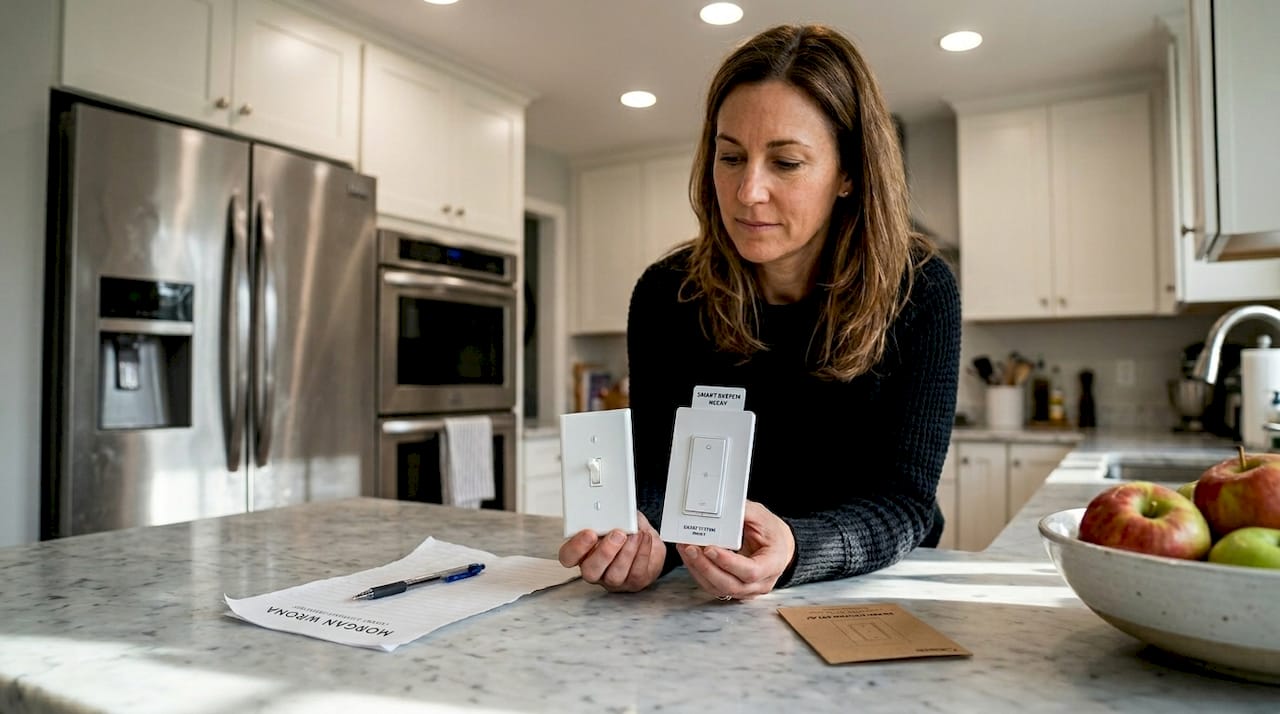
Standby power draw is worth understanding. Each smart device consumes a small amount of power even when not in use. Across a large home with many nodes, this can add up, though it remains a secondary consideration compared to the system’s overall performance.
RGB bulbs and dense WiFi networks can also cause interference. If your home already has significant wireless demand from other devices, a system using a dedicated mesh protocol such as Zigbee or Z-Wave will perform more consistently than one relying on your main WiFi network.
For modern lighting design, the guiding principle is to build around the architecture first. Consider the three-layer approach before selecting any hardware, and work with a bespoke lighting scheme that reflects how each room is actually used.
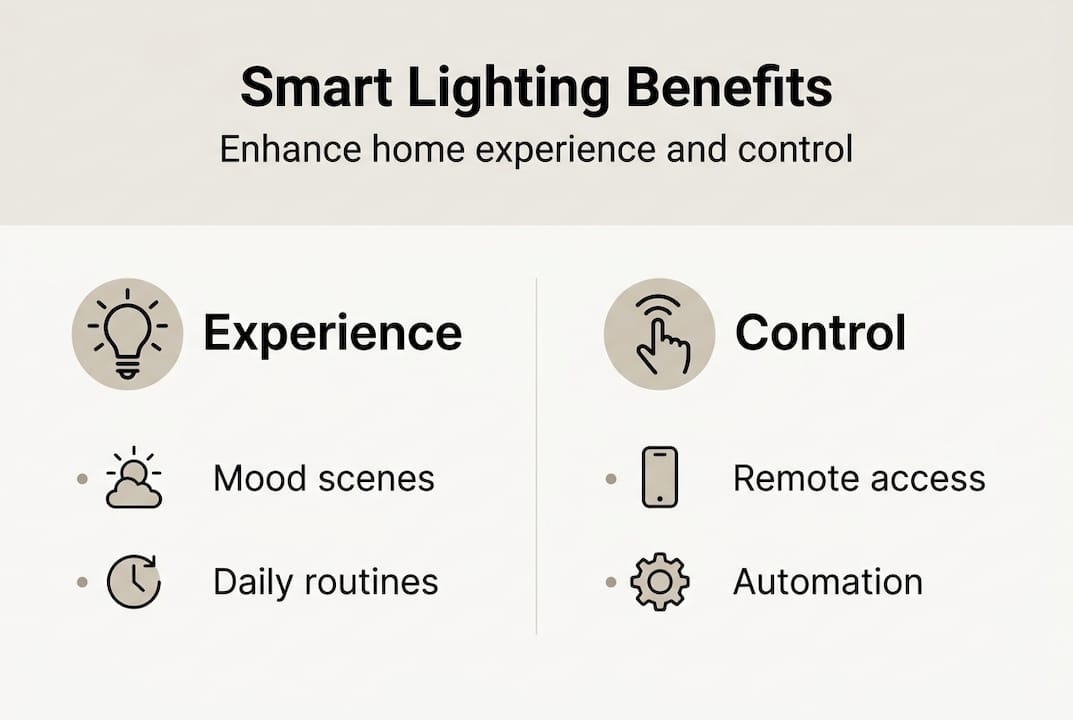
Pro Tip: Avoid specifying mains smart bulbs as your primary control method. Relay-based systems are more reliable, integrate more cleanly with central controls, and are easier to service over time.
How to maximise smart lighting benefits in your home
Now let us put it all together with straightforward steps to future-proof your smart lighting scheme. Planning before installation is where most of the value is created. Decisions made at the design stage shape everything that follows.
Day-one planning checklist:
- Map your zones: identify which rooms need independent control and which can be grouped
- Define your routines: morning, working, evening, and night modes for each key space
- Choose your control method: wall panels, voice, app, or automated triggers
- Confirm your infrastructure: relay or bulb, WiFi or mesh protocol
- Integrate with other systems: blinds, heating, and security where relevant
- Plan for aftercare: ensure your installer offers commissioning support and future adjustments
Research into layered, adaptive lighting consistently shows this approach best supports lifestyle and long-term satisfaction. Homes with well-zoned lighting report up to a 68% improvement in perceived comfort, a figure that reflects how profoundly the right light in the right place changes how a space feels to live in.
Practical steps to avoid common pitfalls:
- Test scenes before finalising: live with them for a few days before locking settings
- Avoid over-automation: leave manual override options so the system feels supportive, not restrictive
- Label zones clearly in your control interface so every household member can use the system confidently
- Review routines seasonally, as natural light levels change significantly across the UK year
For a structured approach, the step-by-step lighting integration process and guidance on smart home lighting control offer practical frameworks that translate well to architect-led properties of varying scale.
What most guides get wrong about smart lighting
Most articles on smart lighting open with energy savings and close with payback periods. We understand why: it is a tangible number. But it consistently misses the point for homeowners who have invested in an architecturally considered home.
The real measure of a smart lighting system is whether it amplifies the intent of the space. A well-designed room should feel different at eight in the morning than it does at eight in the evening. Lighting is the tool that makes that possible, and layered design and relay-based controls are what define long-term satisfaction, not wattage figures.
The impact on living spaces is emotional as much as functional. A home that responds intuitively to how you live in it creates a quiet sense of ease that is difficult to quantify but immediately felt. That is the standard worth designing towards.
Discover advanced home lighting solutions
If you are considering a smart lighting scheme for your home, the quality of the design and installation process makes a significant difference to the outcome you experience every day.
We work with homeowners and their architects to plan and install lighting systems that are genuinely bespoke, from initial consultation through to commissioning and ongoing support. Our lighting automation overview sets out what is possible, and our lighting control workflow guide walks through the process in practical terms. For tailored advice on automated lighting suited to your property, contact us or call [01793 315930](tel:01793 315930).
Frequently asked questions
Do smart lighting systems really save energy?
Smart lighting can reduce energy use, but savings per lamp are modest at £6 to £15 per year, and the rebound effect often reduces the net gain as people enjoy better light more freely.
What is the rebound effect in smart lighting?
The rebound effect occurs when improved efficiency leads to increased use, meaning comfort-driven behaviour offsets a portion of the expected energy savings.
Are relays better than smart bulbs for whole-home lighting?
Yes. Relays offer greater reliability and integrate more cleanly with central control systems, making them the preferred choice for mains lighting in architect-designed homes.
How do I future-proof my smart lighting investment?
A layered, adaptive design built around relay-based controls, clearly defined zones, and flexible routines gives your system the best foundation for evolving with your needs over time.