Finding lighting that adapts intelligently to your needs and complements architectural design is more than just adding a few app-controlled bulbs. For homeowners in London and the South East, quality smart lighting means systems that respond to daily routines, support comfort, and work seamlessly with the flow of your home. With technology offering over 40% additional energy savings and refined light quality, you gain both efficiency and style—all without visible gadgetry disrupting your interior.
Table of Contents
- Smart Lighting – What It Actually Means
- Key Types and How They Differ
- How Smart Lighting Shapes Daily Life
- Integration with Architecture and Design
- Long-Term Value, Costs, and Considerations
Key Takeaways
| Point | Details |
|---|---|
| Smart Lighting Defined | It integrates intelligent sensing technology and internet capabilities, adapting to environmental conditions and user preferences. |
| Types of Systems | Options include Centralised Control, Zoned Systems, and Hybrid Approaches, each suited to different home layouts and needs. |
| Impact on Daily Life | Smart lighting enhances mood and well-being by aligning with natural circadian rhythms, improving safety and cognitive function. |
| Long-Term Value | Initial investments in smart lighting often lead to significant energy savings and can enhance property value over time. |
Smart Lighting – What It Actually Means
Smart lighting is often misunderstood as simply “lighting that works with your phone.” The reality is far more considered and sophisticated than that.
At its core, smart lighting represents a transition from conventional analogue to digital lighting that integrates intelligent sensing technology with internet capabilities. Rather than static fixtures that turn on and off, these systems respond to their environment, learning your patterns and adjusting automatically.
What makes this different from traditional dimmer switches or timers?
- Sensing and adaptation. Smart systems detect occupancy, daylight levels, and time of day, then adjust brightness and colour temperature without you asking.
- User preferences. The system learns what you prefer at different times and gradually refines its behaviour accordingly.
- Energy optimisation. By matching light output precisely to actual need, intelligent systems adjust brightness and colour based on environmental conditions, reducing unnecessary consumption.
- Integration. These systems communicate with other home elements—heating, security, entertainment—creating seamless coordination.
In your London townhouse or Surrey home, this might look like this: you enter your sitting room on a grey afternoon, and the lights automatically brighten to compensate. Later, as dusk approaches, they gradually warm in colour temperature, supporting your natural circadian rhythm. When you leave the room, they fade rather than switching off abruptly.
Smart lighting solves a genuine problem—the gap between what fixed lighting provides and what you actually need in any given moment.
This isn’t about gadgetry for its own sake. It’s about systems that understand your space and adapt to how you genuinely live. The technology works in the background, becoming invisible once properly configured.
The distinction matters because quality smart lighting optimises light quality and energy consumption simultaneously, offering over 40% additional energy savings compared to conventional systems. That’s measurable benefit, not marketing language.
The approach differs fundamentally from retrofit smart bulbs or basic automation. Integrated smart lighting is designed during the architectural planning phase, working with your home’s design language and layout from the start.
Pro tip: Discuss smart lighting possibilities with your architect or designer during the initial design phase, not as an afterthought—this ensures wiring, control points, and system architecture align perfectly with your home’s intended flow.
Key Types and How They Differ
Smart lighting systems come in different configurations, each suited to different homes and priorities. Understanding these distinctions helps you choose what actually works for your space.
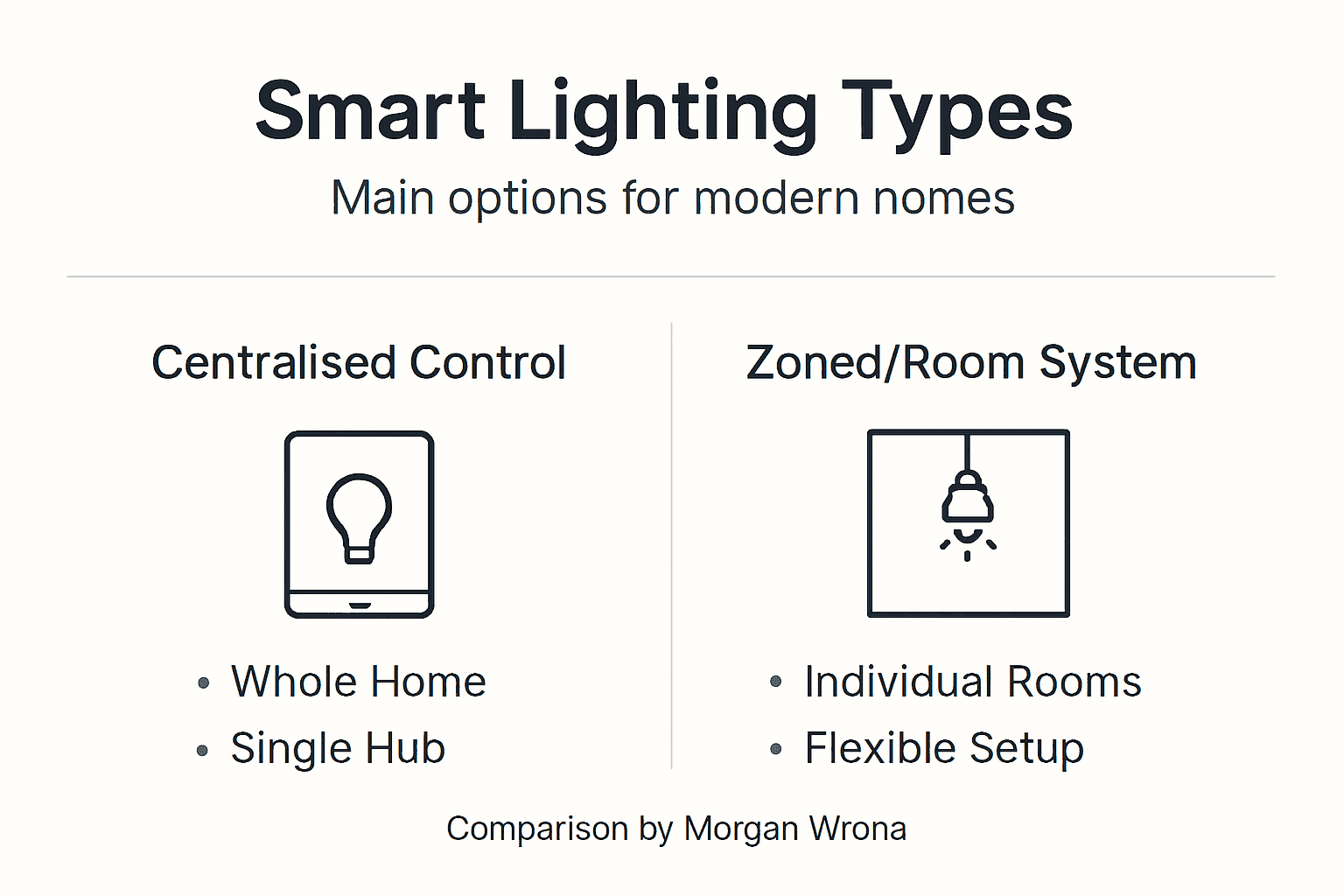
Centralised Control Systems
These integrate all your lighting through a single control hub that manages the entire home. Everything communicates through one network, making coordination seamless.
- Single point of control. One app, one interface, one logic system managing every light.
- Whole-home coordination. Lighting talks to heating, security, and entertainment simultaneously.
- Consistent behaviour. All lights follow the same rules and respond identically to triggers.
- More reliable. Fewer individual components means fewer points of failure.
For a Georgian property in Mayfair or a contemporary home in the Cotswolds, centralised systems provide architectural elegance—wiring is planned comprehensively from the start, hidden within walls and ceiling voids.
Zoned or Room-by-Room Systems
These allow different areas of your home to operate independently, each with its own settings and schedules.
- Flexibility. Your kitchen operates on different logic than your bedroom.
- Partial implementation. Add zones gradually rather than renovating the entire home at once.
- Privacy. Family members can control their spaces without affecting others.
Zoned systems work well when your home has distinct living areas with different purposes and lighting demands.
This approach suits period properties where running comprehensive wiring everywhere would be intrusive or impractical.
Hybrid Approaches
Many homes benefit from combining both strategies. Your main living spaces might use centralised control for seamless coordination, whilst bedrooms remain independent zones.
This balances convenience with flexibility. You get sophisticated automation where it matters most, without over-engineering spaces where simpler control makes sense.
To help clarify the main smart lighting system types, here is a side-by-side comparison:
| System Type | Best Suited To | Coordination Level | Installation Complexity |
|---|---|---|---|
| Centralised Control | Large or open-plan homes | Whole-house, unified logic | Requires comprehensive wiring |
| Zoned (Room-by-Room) | Period properties, individual needs | Independent room logic | Minimal disruption per area |
| Hybrid | Homes with varied living spaces | Mix of central and local | Flexible, tailored by area |
What Actually Matters in Your Home
The choice between these types depends on three things:
- Your property’s layout and architecture. Open-plan homes naturally suit centralised systems; period properties with distinct rooms often prefer zones.
- How you actually live. Do you want consistency across your entire home, or do different spaces serve different purposes?
- Future-proofing. Centralised systems scale more easily if you add extensions or renovate.
Neither approach is inherently “better.” The right system is the one that matches your home’s character and your daily reality.
Pro tip: During your initial consultation, ask your lighting designer which approach aligns with your property’s architectural style and how you move through your home—this determines whether centralised or zoned logic will feel intuitive daily.
How Smart Lighting Shapes Daily Life
Smart lighting doesn’t just control brightness. It affects how you feel, think, and move through your home each day.

The impact starts the moment you wake. Human-centric lighting techniques improve mood and cognitive performance by aligning light with your natural circadian rhythms. Your bedroom gradually brightens before dawn, signalling your body to wake naturally. Your kitchen delivers cooler, brighter light that sharpens focus for breakfast and planning the day ahead.
As afternoon drifts into evening, the system shifts gradually. Warm tones emerge. Brightness softens. Your body recognises the transition and begins preparing for sleep naturally, without you consciously adjusting anything.
Beyond Convenience
This isn’t simply about comfort, though that matters. The benefits span three distinct areas:
- Mood and well-being. Proper light at proper times reduces fatigue and seasonal mood variation.
- Safety and visibility. Hallways and stairs illuminate automatically as you move through them, eliminating fumbling for switches.
- Cognitive function. Alert lighting in working areas genuinely improves focus and decision-making.
In a home office where you spend hours at a desk, smart lighting prevents the mental fog that comes from poor illumination. In a hallway or kitchen late at night, it guides you safely without harsh overhead lights that jolt you awake.
Integration with building automation systems makes these benefits automatic and invisible—the system adjusts as conditions change, without requiring conscious input.
Your sitting room naturally adapts to grey London afternoons. Your bedroom supports better sleep through gradual dimming. Your kitchen feels energised without feeling clinical. Each space serves its purpose more effectively because the lighting actually supports what you’re doing there.
The Practical Effect
When properly configured, you stop thinking about lighting entirely. You don’t adjust switches constantly. You don’t squint at screens under harsh overhead lights. You don’t lie awake because your bedroom is too bright.
The system works around your life, not the other way around.
This is why design-led smart lighting matters. It’s not gadgetry. It’s about understanding how light affects your daily experience and designing systems that support genuine well-being.
Pro tip: Request a lighting demonstration during your consultation that shows how brightness and colour temperature will shift throughout the day—seeing this live helps you understand how the system will feel in practice.
Integration with Architecture and Design
Smart lighting isn’t retrofitted technology bolted onto your home. When properly conceived, it becomes part of your home’s architectural language from the start.
This distinction matters enormously. A system designed during the architectural phase works with your space, not against it. Wiring paths follow structural logic. Control points sit where they feel natural. The technology disappears into the design.
Design-Led Thinking
Consider how your architect approaches materials, spatial flow, and proportions. Smart lighting deserves the same rigorous design thinking.
The right approach involves three stages:
- Design integration. Lighting strategy is developed alongside architectural plans, not added as an afterthought.
- Spatial planning. Control points, wiring routes, and sensor placement align with your home’s layout and aesthetics.
- System commissioning. The entire system is tuned specifically for your spaces, not installed generically.
In a period townhouse, this might mean concealing wiring within existing plasterwork or cornicing. In a contemporary build, it could involve embedding controls within joinery. The principle remains constant: the technology serves the design, never the reverse.
Why This Matters
Smart lighting systems provide flexible and scalable solutions that align with design aesthetics rather than dominating your home’s visual character. Properly integrated systems are often invisible—you notice the quality of light, not the equipment creating it.
This affects everything from how you move through spaces to how your home photographs and feels. Visible switches, exposed cabling, or poorly positioned sensors break the design narrative you’ve worked hard to establish.
Architectural integration means your lighting system enhances your home’s character rather than compromising it through poor placement or visible infrastructure.
The Practical Outcome
When lighting is considered early, several benefits emerge naturally:
- Elegant control points positioned logically within room layouts.
- Concealed wiring that doesn’t compromise walls or ceilings.
- Sensor placement that’s both functional and visually discreet.
- Seamless operation that feels intuitive within your home’s spatial logic.
Your architect or designer should engage lighting specialists during the planning phase, not near completion. This conversation shapes decisions about ceiling heights, wall construction, and material choices that affect how lighting performs.
The result feels effortless because it is—the system was designed for your specific spaces from the beginning.
Pro tip: If working with an architect or designer, introduce your lighting specialist early in the design phase so wiring strategies, control locations, and sensor placement can be planned comprehensively rather than improvised during installation.
Long-Term Value, Costs, and Considerations
Smart lighting requires upfront investment. The question isn’t whether there’s a cost—it’s whether the long-term benefits justify that investment. For most homeowners in architecturally significant properties, the answer is yes.
Understanding the Initial Investment
The upfront costs include LED technology, advanced controls, sensors, and professional installation. This isn’t comparable to standard lighting retrofits. You’re investing in infrastructure that will support your home for 10–15 years or longer.
However, prices are shifting. Rapid technological advancements and energy policies are driving down smart lighting costs significantly. What cost substantially five years ago is considerably more accessible now.
The Financial Case Over Time
Energy efficiency improvements through smart lighting translate into measurable cost savings despite the upfront investment. Most homeowners see returns through:
- Energy consumption reduction. Smart systems use 40% less energy than conventional lighting through precise control and optimisation.
- Reduced waste. Lights don’t remain on unnecessarily; the system adjusts automatically based on occupancy and daylight.
- Longevity. LED technology lasts considerably longer than traditional bulbs, reducing replacement frequency and cost.
- Property value. Integrated smart systems appeal to future buyers, supporting resale value.
The payback period typically spans 5–7 years through energy savings alone, with the system continuing to deliver value long after that investment is recovered.
Beyond Energy Savings
Financial value extends beyond utility bills. Quality of life improvements—better sleep, improved focus, reduced fatigue—carry genuine value that doesn’t appear on invoices.
Smart lighting offers a range of long-term benefits beyond simple energy savings:
| Benefit Area | Short-Term Advantage | Long-Term Value |
|---|---|---|
| Energy Efficiency | Reduced monthly bills immediately | Payback within 5–7 years |
| Well-being | More comfortable, adaptive lighting | Improved sleep and mood year-round |
| Home Value | Enhanced property appeal | Increased resale potential for future buyers |
| Maintenance | Less frequent lamp replacements | Lower overall costs over 10–15 years |
Additionally, some energy suppliers and local authorities offer grants or incentives for homes implementing smart energy management systems. These can offset initial costs meaningfully.
Key Considerations Before Committing
Three factors deserve careful thought:
- System interoperability. Ensure components communicate reliably and that the system isn’t dependent on a single manufacturer or proprietary platform.
- Future adaptation. Technology evolves; choose systems with upgrade potential rather than those requiring complete replacement.
- Integration scope. Consider whether you’re lighting your entire home or phasing in different areas over time.
During your consultation, ask about total cost of ownership, energy savings projections specific to your home, and warranty coverage. Transparent pricing and realistic timelines matter more than lowest initial quotes.
Pro tip: Request a detailed energy audit and savings projection tailored to your specific home before committing—this transforms abstract financial claims into concrete numbers relevant to your situation.
Intelligent Lighting That Understands Your Home
Smart lighting addresses the persistent challenge of fixed lighting systems that fail to adapt to your daily life or home architecture. The article highlights how integrated systems adjust brightness and colour temperature to support well-being, energy efficiency, and seamless living. For homeowners of architecturally thoughtful properties, this means lighting that complements your home’s design rather than disrupting it, delivering subtle enhancements that quietly improve comfort and energy use.
At Morgan Wrona, we collaborate closely with architects and designers from the earliest stages to ensure your intelligent lighting system is woven into your home’s fabric. From comprehensive consultation through careful system design, expert installation and fine commissioning to ongoing support, we help you move beyond basic retrofit solutions. Our approach considers the specific spatial flow of your property, giving you control where you want it and automation where it benefits your daily rhythm.
Explore how our bespoke lighting solutions can adapt your living spaces with precision and sensitivity on our main website and discover how thoughtful integration transforms your home’s atmosphere. For a deeper conversation about tailoring intelligent lighting to your lifestyle and property type, please visit our lighting consultation page or contact us directly.
If you would like to discuss how this could work in your home, contact us or call 01793 315930.
Frequently Asked Questions
What is smart lighting?
Smart lighting refers to a digital lighting system that integrates intelligent sensing technology and internet capabilities, enabling lights to respond to environmental changes and user preferences.
How does smart lighting improve energy efficiency?
Smart lighting systems optimise brightness and colour based on occupancy and daylight levels, which reduces unnecessary energy consumption by up to 40% compared to conventional lighting systems.
What are the main types of smart lighting systems?
Smart lighting systems can be centralised control systems, which manage all lights from a single hub, zoned systems that allow different areas to operate independently, or hybrid systems that combine both approaches based on the home’s layout and needs.
How can smart lighting enhance daily life?
Smart lighting can improve mood, cognitive function, and safety by providing adaptable illumination that aligns with natural circadian rhythms, ensuring spaces are well-lit when needed while being gentle on the eyes during the evening.