Settling into your carefully designed cinema room only to find the lights ruin the mood is a frustration many London and South East homeowners know too well. Lighting control in home cinemas is about more than brightness—it’s about crafting a viewing environment that blends effortlessly with your architecture and daily life. By focusing on bespoke lighting control, you transform not just what you see on screen, but how every moment in your cinema space feels, making each film night truly memorable.
Table of Contents
- Lighting Control In Home Cinemas Defined
- Types Of Lighting Used In Cinema Rooms
- Design-Led Integration With Architecture
- Practical Effects On Experience And Use
- Common Challenges And How To Avoid Them
Key Takeaways
| Point | Details |
|---|---|
| Lighting Control is Integral | Effective lighting in home cinemas enhances the viewing experience, prioritising immersion over mere visibility. |
| Three-Point Lighting is Essential | Utilising key, fill, and backlighting ensures depth and atmosphere that create a true cinematic environment. |
| Design Integration Matters | Thoughtful integration of lighting with architectural features ensures a seamless and harmonious space, enhancing overall aesthetics. |
| User-Friendly Systems are Crucial | Intuitive control systems that respond automatically significantly improve usability and prevent frustration during film viewing. |
Lighting Control in Home Cinemas Defined
Lighting control in a home cinema is far more than switching lights on and off. It’s about creating an environment where every viewing experience feels intentional, immersive, and perfectly suited to your space.
At its core, lighting control involves managing artificial light sources through dimming systems and automated controls to adjust illumination levels based on what you’re watching. This isn’t generic overhead lighting—it’s a carefully orchestrated system that adapts to your needs.
What Makes It Different from Standard Home Lighting
Your living room lights and your cinema lighting serve entirely different purposes. Standard lighting prioritises visibility and general comfort. Cinema lighting prioritises atmosphere, image clarity, and the viewing experience itself.
When you watch a film in a properly lit cinema space, you notice the difference immediately. The light doesn’t wash out the screen. It doesn’t create glare that catches your eye. Instead, it complements what’s happening on screen and fades into the background when the film demands your full attention.
The Key Components of Lighting Control
Effective cinema lighting control combines three essential elements:
- Dimmable LED lights positioned to avoid glare and preserve audio clarity
- Smart control systems that let you adjust lights through remotes, wall panels, or apps
- Automated responses that dim or brighten based on content, time of day, or your preferences
These work together seamlessly. You’re not managing separate systems—everything communicates and responds as one integrated environment.
Why This Matters for Your Home
In architect-designed homes across London and the South East, lighting control becomes part of the overall design language. It’s not an afterthought bolted onto a media room. It’s integrated from the beginning, working with your room’s proportions, finishes, and existing architectural features.
Effective lighting placement avoids glare while preserving audio clarity—a subtle but critical detail. When light bounces onto your screen or disrupts your sightlines, it diminishes every improvement you’ve made to your audio and video systems.
Lighting control transforms a room from a functional viewing space into a thoughtfully calibrated environment where every element serves the film.
How It Shapes Your Experience
Consider the difference between watching a thriller with harsh overhead lighting versus controlled, dimmed ambient light. One breaks tension. The other builds it. Consider a drama where subtle colour changes in the light enhance emotional moments, or a comedy where brighter, warmer tones add to the mood.
Lighting control gives you this flexibility. You’re not locked into one setting. You adapt the room to match the content, your mood, and the time of day.
Pro tip: Start by identifying where light spills onto your screen or creates unwanted reflections, then plan your dimming zones around those problem areas rather than treating the room as one uniform lighting space.
Types of Lighting Used in Cinema Rooms
Your cinema room likely uses several different types of lighting working together. Each serves a specific purpose, from setting mood to ensuring visibility. Understanding how they work transforms a basic room into a truly cinematic space.
The Foundation: Three-Point Lighting
Three-point lighting forms the backbone of effective cinematic design. This classic approach uses key light, fill light, and backlight to create depth, mood, and visual focus. It’s the framework professional filmmakers have used for decades—and it works just as effectively in your home.
The key light is your primary source. It illuminates the main subject or area you want viewers to focus on. In a cinema room, this might be accent lighting that highlights architectural features or creates visual interest without overwhelming the screen.
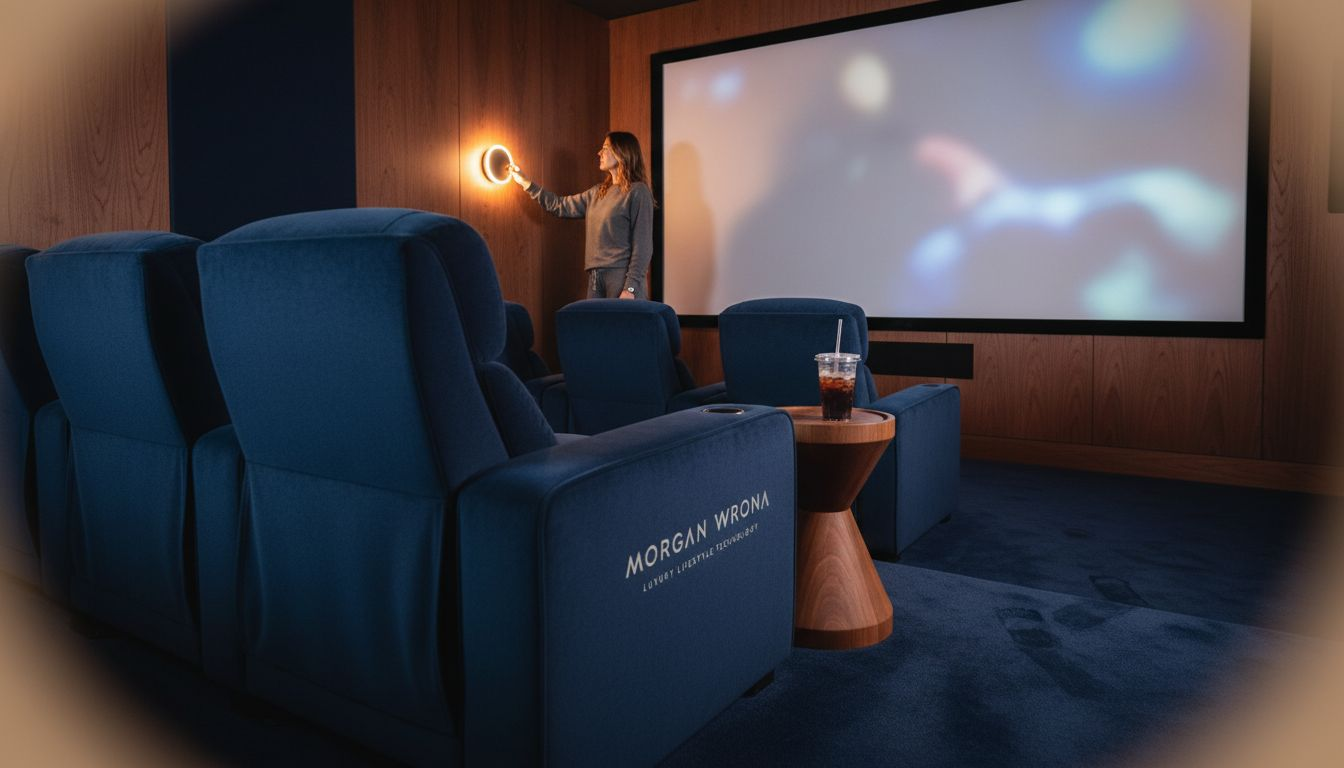
Fill light softens harsh shadows created by the key light. It adds definition without introducing unwanted contrast. In your room, this could be ambient lighting that ensures no area falls into complete darkness during a film.
Backlight sits behind objects or along walls, creating separation and depth. This lighting type prevents your space from feeling flat and adds dimension that makes the room feel more cinematic.
Here is a comparison of lighting types and their impact on the home cinema experience:
| Lighting Type | Main Purpose | Impact on Experience |
|---|---|---|
| Key Light | Highlights focal areas | Draws attention, adds drama |
| Fill Light | Softens harsh shadows | Balances ambience, reduces eye strain |
| Backlight | Creates separation and depth | Enhances dimensionality |
| Ambient Lighting | Provides overall visibility | Maintains comfort and safety |
| Accent Lighting | Emphasises features | Adds sophistication, enhances mood |
Lighting Styles That Shape Mood
Beyond individual light types, cinema rooms employ different lighting styles to match content and atmosphere:
- Low-key lighting uses deep shadows and minimal fill, perfect for thrillers and dramatic scenes that demand tension
- High-key lighting balances light evenly across the space, ideal for comedies and lighter content that needs brightness
- Practical lighting uses visible fixtures—lamps, wall sconces—that feel natural to the environment
The Technology Behind the Control
LED lights with diffusers give you precise control over colour temperature and intensity. Warm tones (2700–3000K) feel intimate and cinema-like. Cooler tones (4000–5000K) feel modern and alert. The ability to shift between them means your room adapts to whatever you’re watching.
Dimmability is essential. You’re not choosing between fully on or fully off—you’re selecting exact brightness levels that support the film’s mood without competing with your screen.
Different lighting types work together to create atmosphere, not just visibility. The right combination makes viewing feel intentional rather than accidental.
Pro tip: Start by mapping where each light type should sit in your room—key light near the screen, fill light in seating areas, backlight along the perimeter—then select fixtures that can dim smoothly without flickering.
Design-Led Integration With Architecture
In architect-designed homes, lighting doesn’t exist separately from the space itself. It’s woven into the room’s bones, responding to the architecture rather than fighting against it. This integration is what separates a functional cinema from a truly considered one.
Why Architecture Matters for Lighting
Your home’s proportions, materials, and existing features all influence how light behaves. A room with high ceilings needs different lighting placement than a basement conversion. A space with exposed brickwork reflects light differently than plasterboard. Ignoring these realities means installing systems that work against your architecture rather than with it.
When lighting integrates thoughtfully with design, something shifts. The room feels less like a media space bolted onto your home and more like a natural extension of how you live.
Creating the Cinematographic Cocoon
Strategic use of lighting and spatial elements can create an immersive environment where film becomes the focus without the room feeling disconnected from the rest of your home. This balance matters, especially in London and the South East where many properties blend period features with contemporary living.
Architectural features like alcoves, ceiling heights, and wall finishes become your toolkit. Accent lighting in an alcove becomes purposeful. Ceiling-mounted fixtures work with your room’s proportions rather than against them. Wall colours enhance or soften the light as needed.
Key Principles for Integration
Design-led lighting integration follows these foundations:
- Work with existing materials – stone, wood, brick all reflect light differently; design around them
- Respect proportions – ceiling height and room dimensions determine fixture placement and intensity
- Plan for flexibility – your cinema functions differently at night than during day; lighting must adapt
- Hide infrastructure – wiring, dimmers, and control systems should disappear into the architecture
- Consider sight lines – no fixture should create glare or distract from your screen
The Consultation Process Matters
This level of integration doesn’t happen by accident. It requires understanding your space, your lifestyle, and your architectural style before specifying a single light fixture.
A proper design process includes site visits, detailed discussions about how you actually use the room, and careful consideration of your existing décor and finishes. The result feels inevitable—as if the lighting was always meant to be there.
Lighting that respects your architecture feels like part of the home, not an afterthought. It serves the film without drawing attention to itself.
Pro tip: Bring reference images of cinema spaces you admire to your initial consultation—not to copy them, but to show your designer how light integrates with architecture in ways that resonate with you.
Practical Effects on Experience and Use
Lighting control isn’t abstract theory. It shapes how you actually use your cinema room day after day. The difference between poor lighting and thoughtful lighting becomes obvious the moment you press play.
How Lighting Changes Your Emotional Response
Programmable lighting adjusted to match content moods increases emotional engagement and overall satisfaction. When watching a thriller, darker, cooler tones heighten tension. During a comedy, warmer, brighter tones feel more inviting. Your brain responds to these cues whether you consciously notice them or not.
This isn’t manipulation—it’s enhancement. The filmmaker intended certain emotional beats. Proper lighting simply reinforces them.
Immersion Through Colour and Brightness
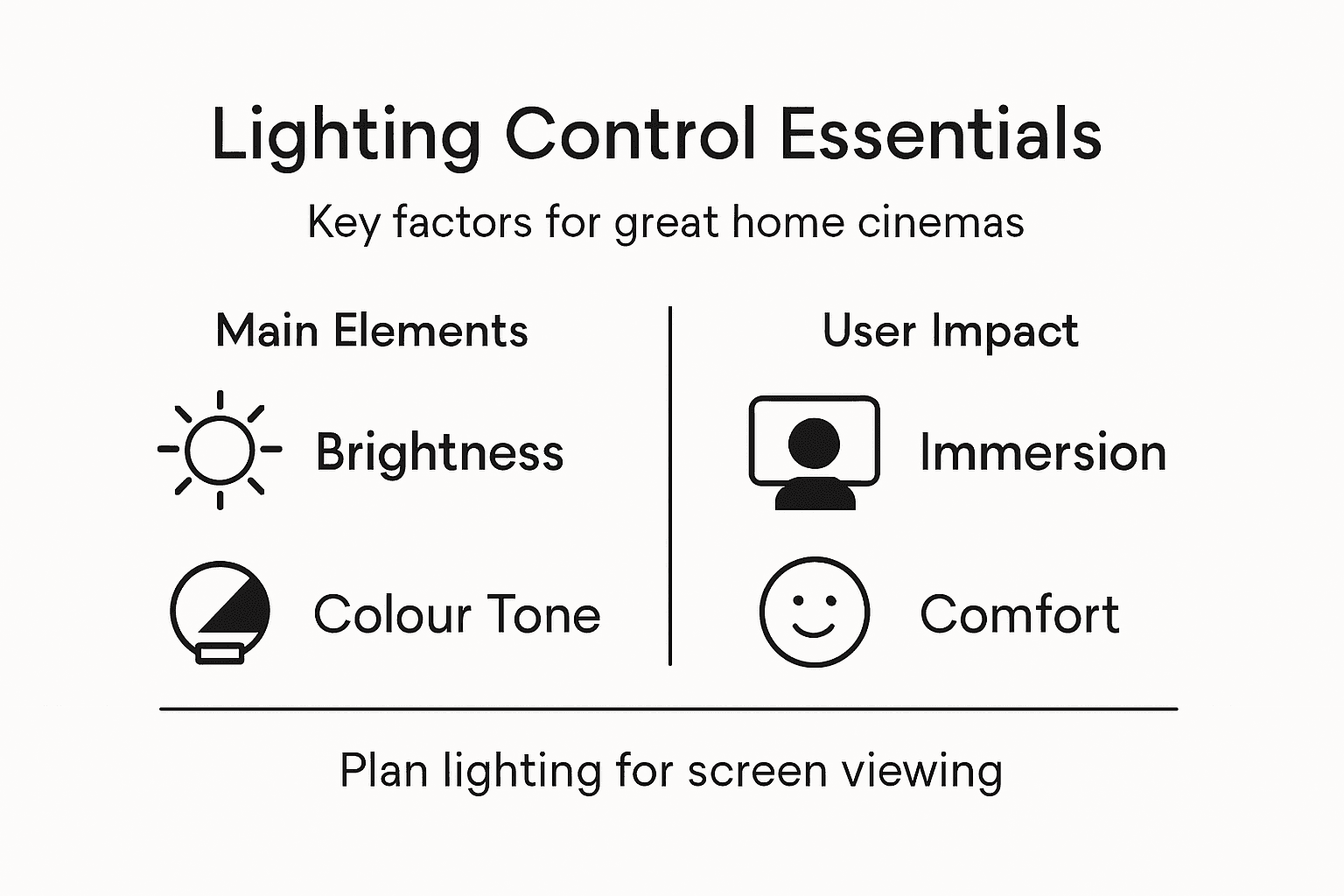
Colour temperature has measurable effects on how you feel. Warm light (2700K–3000K) creates intimacy and comfort. Cool light (5000K+) feels alert and clinical. By adjusting lighting throughout a film, you’re not just setting a mood—you’re synchronising your environment with the story.
Brightness matters equally. Too much ambient light washes out your screen and breaks immersion. Too little creates eye strain. The right balance means you forget you’re in a room watching a screen. You’re simply there, present in the story.
Practical Daily Use
Lighting control affects more than film viewing. It shapes how your cinema room functions throughout the day:
- Entertainment – films, television, gaming all benefit from adjustable lighting that matches content
- Social gathering – brighter settings for hosting without overwhelming guests
- Daytime use – flexibility to work or read comfortably when the room isn’t darkened
- Transition times – gradual dimming prevents jarring shifts between brightness levels
The Difference Between Adequate and Considered
Many cinema rooms have dimmers. Few have lighting that truly responds to what’s on screen. The difference is control without thought versus control with intention.
With proper programmable systems, you create presets for different scenarios. A thriller preset differs from a sports preset. You’re not adjusting lights manually—the system handles it, learning your preferences over time.
Effective lighting control transforms viewing from tolerable to genuinely immersive. You stop noticing the technology and simply experience the film.
User Experience in Practice
Consider a typical evening. You arrive home, settle in, and press play. Intelligent lighting responds automatically—dimming to appropriate levels, adjusting colour temperature to match content, all without a second thought. By the end of the film, you’ve experienced it exactly as intended, undistracted by light spill or glare.
This seamless experience is what design-led control provides. The technology becomes invisible because it anticipates your needs.
Pro tip: Create separate lighting scenes for different genres—thriller, drama, comedy, sports—and test how each feels over several viewings before finalising settings.
Common Challenges and How to Avoid Them
Lighting control systems can fail in subtle ways if planned poorly. Understanding common pitfalls means you avoid expensive mistakes and end up with a system that genuinely serves your needs.
Technical Complexity and Integration
Many homeowners discover too late that their lighting system doesn’t communicate with their audio-visual setup. Worse, they realise their chosen fixtures aren’t compatible with their control platform. System compatibility issues and installation complexity create frustration and expense.
The solution starts early. Before selecting any hardware, map out your entire system architecture. What controls what? How do systems talk to each other? This planning prevents costly retrofits.
User-Friendliness Gets Overlooked
A sophisticated system nobody uses is worthless. If adjusting lights requires opening an app, navigating menus, and remembering preset names, you’ll default to manual switches within weeks.
Intuitive interfaces matter more than feature lists. Simple wall panels, voice control, or automatic presets that respond to time of day all beat complex smartphone apps. Your system should work without thinking.
Energy Efficiency Concerns
LED technology is efficient, but poor control design wastes energy. Lights left on because dimming seems complicated, or systems that don’t adjust based on daylight, add unnecessary cost.
Effective design balances control flexibility with energy awareness. Automated scheduling, daylight harvesting, and occupancy-based dimming all reduce consumption without reducing functionality.
Common Installation Mistakes to Avoid
These errors surface repeatedly:
The following table summarises typical lighting control mistakes and how to prevent them:
| Common Mistake | Effect on Cinema Use | Proactive Solution |
|---|---|---|
| Insufficient dimmer power | Flickering, system failure | Specify dimmers for total load |
| Poor cable management | Difficult upgrades, faults | Use conduit, plan cable routes |
| Incompatible fixtures | Unreliable dimming, odd behaviour | Match fixtures to control system |
| Limited flexibility | Cannot adapt to new needs | Allow for system expansion |
- Insufficient dimmer capacity – undersized dimmers cause flickering and premature failure
- Poor cable routing – wiring hidden in walls without proper conduit makes future changes impossible
- Inadequate backup power – losing all control when the mains fails creates frustration
- Incompatible fixtures – mixing LED and traditional bulbs on the same dimmer creates problems
- Ignoring future flexibility – systems installed without room for expansion become restrictive
The Role of Professional Design
Careful planning of control architecture and user-centric design prevents most problems. This isn’t something to handle alone. A proper design consultation addresses hardware reliability, ease of use, and how your system integrates with your home’s existing infrastructure.
This is where the consultation process protects you. Experienced installers identify potential conflicts before they become expensive problems.
Poor lighting control feels like a feature that works against you. Good control feels like it doesn’t exist—it simply responds to what you need.
Pro tip: Request a detailed system diagram showing all fixtures, dimmers, control points, and communication pathways before installation begins—this catches compatibility issues before any wiring happens.
Enhancing Your Home Cinema Experience Through Thoughtful Lighting Control
Creating the perfect home cinema environment requires more than quality screens and sound. As the article highlights, managing lighting with precision transforms your room into an immersive space where every film, drama, or game feels intentional and comfortable. Poorly considered lighting can cause glare, distract from the screen, or diminish audio clarity, while well-designed lighting control supports your viewing experience and complements your home’s architecture.
At Morgan Wrona, we understand that lighting control should be an integrated and flexible part of your home. By working closely with architects and homeowners, we ensure your lighting responds naturally to the room’s proportions, finishes, and your lifestyle. This means:
- Avoiding unwanted reflections on your screen
- Creating adaptable lighting scenes that match the mood of your content
- Seamlessly integrating controls that require no complex operation
To explore how considered lighting control can elevate your home cinema and everyday living, visit our home page and learn about our consultation and design process.
If you would like to discuss how intelligent lighting transforms your home cinema or broader living environment, contact us or call 01793 315930.

Frequently Asked Questions
What is lighting control in home cinemas?
Lighting control in home cinemas involves managing artificial light sources to enhance the viewing experience. This includes dimming systems and automated controls that adjust illumination levels based on the content being watched, ensuring that light complements the film rather than distracts from it.
How does cinema lighting differ from standard home lighting?
Cinema lighting prioritises atmosphere and image clarity, whereas standard home lighting focuses on general visibility and comfort. In a well-lit cinema room, the lighting creates an immersive environment that enhances the viewing experience without causing glare or distractions.
What are the key components of an effective lighting control system?
An effective lighting control system includes dimmable LED lights, smart control systems that allow for easy adjustments, and automated responses based on time of day or content type. These elements work together to create a cohesive lighting environment that enhances your cinema experience.
How can lighting control enhance the emotional impact of a film?
Lighting control allows for precise adjustments to colour temperature and brightness, which can significantly influence the emotional tone of a film. For example, dimmed, cooler tones can heighten tension in a thriller, while warm, brighter lights can create an inviting atmosphere during a comedy, ensuring viewers remain engaged with the story.