Every London homeowner with a bespoke cinema room knows lighting does far more than keep things dark. The right scheme transforms your architect-designed space, shaping the cinematic mood and daily comfort in equal measure. Proper home cinema lighting replicates the atmosphere of a professional theatre while supporting safe navigation and eye comfort at home. Discover how a thoughtfully layered lighting system brings immersive viewing and flexible living together, making every film night feel intentional and effortless.
Table of Contents
- Defining Home Cinema Lighting And Its Purpose
- Types Of Lighting Used In Cinema Rooms
- Designing For Ambience, Comfort, And Safety
- Integrating Smart Controls And Automation
- Common Mistakes And Architectural Solutions
Key Takeaways
| Point | Details |
|---|---|
| Purpose of Home Cinema Lighting | It aims to create an immersive environment while ensuring comfort, safety, and flexibility for various activities. |
| Layered Lighting Approach | Incorporating ambient, task, and accent lighting enhances mood, navigation, and visual depth. |
| Automation Benefits | Smart controls allow for seamless adjustments, improving functionality and energy efficiency during different viewing experiences. |
| Common Lighting Mistakes | Avoid over-illumination and improper fixture placement to prevent glare and poor visual experiences. |
Defining Home Cinema Lighting and Its Purpose
Home cinema lighting is more than just keeping a room dark. It’s a carefully considered system that shapes how you experience films in your own space. Unlike a commercial cinema, your home theatre must balance immersion with everyday practicality.
At its core, home cinema lighting serves a single mission: to create an environment where the screen commands your attention while you remain comfortable and safe. Proper lighting in home cinemas replicates the focused, controlled atmosphere of a professional theatre adapted for residential living.
Why does this matter to you? A well-designed lighting scheme affects everything from how clearly you see the picture to how your eyes feel after a two-hour film. It’s the difference between squinting at glare and sinking into genuine immersion.
What Home Cinema Lighting Actually Does
Effective home cinema lighting works across several interconnected purposes:
- Controls ambient light to reduce screen glare and contrast issues that strain your eyes
- Sets the cinematic mood through subtle accent lighting that primes you psychologically for viewing
- Provides safety by offering just enough visibility for navigation without disrupting the film experience
- Manages eye comfort by balancing brightness levels between the screen and surrounding surfaces
- Enables flexibility so the space works for film watching, family gatherings, and everyday use
The goal isn’t darkness for its own sake—it’s creating the right visual conditions for both immersion and comfort. Light, when designed thoughtfully, becomes invisible to the viewer.
Many London homeowners assume home cinema lighting means blackout blinds and nothing else. But that’s only part of the equation. The room itself needs layered lighting that you can control and adjust based on time of day, the film being watched, or who’s using the space.
The Three Core Purposes
Break down home cinema lighting into these practical categories:
- Reducing visual interference – Controlling ambient light that bounces onto your screen and degrades the image quality you’ve invested in
- Creating psychological readiness – Using accent lighting and colour temperature to shift your mind into a receptive state
- Supporting daily functionality – Ensuring the room transitions smoothly between dedicated cinema time and normal household use
When you understand these purposes, you can design a lighting scheme that serves the room’s actual needs rather than applying generic rules.
Home cinema lighting also addresses a challenge unique to residential spaces: the room must adapt. Unlike a cinema that only shows films, your home theatre room likely gets used for games, streaming, conversations, or just as a comfortable sitting area. The lighting has to support all these functions gracefully.
Pro tip: Start by observing how natural light enters your cinema room throughout the day, then design your artificial lighting to override it completely during viewing hours whilst remaining practical for non-cinema use.
Types of Lighting Used in home Cinema Rooms
Your cinema room doesn’t work with one type of lighting. It needs a layered approach where different lights serve distinct purposes, working together to create both immersion and functionality.
Think of it like building depth. Each lighting layer handles a specific job, and when they work together, the result feels intentional rather than cobbled together.
The Core Lighting Types
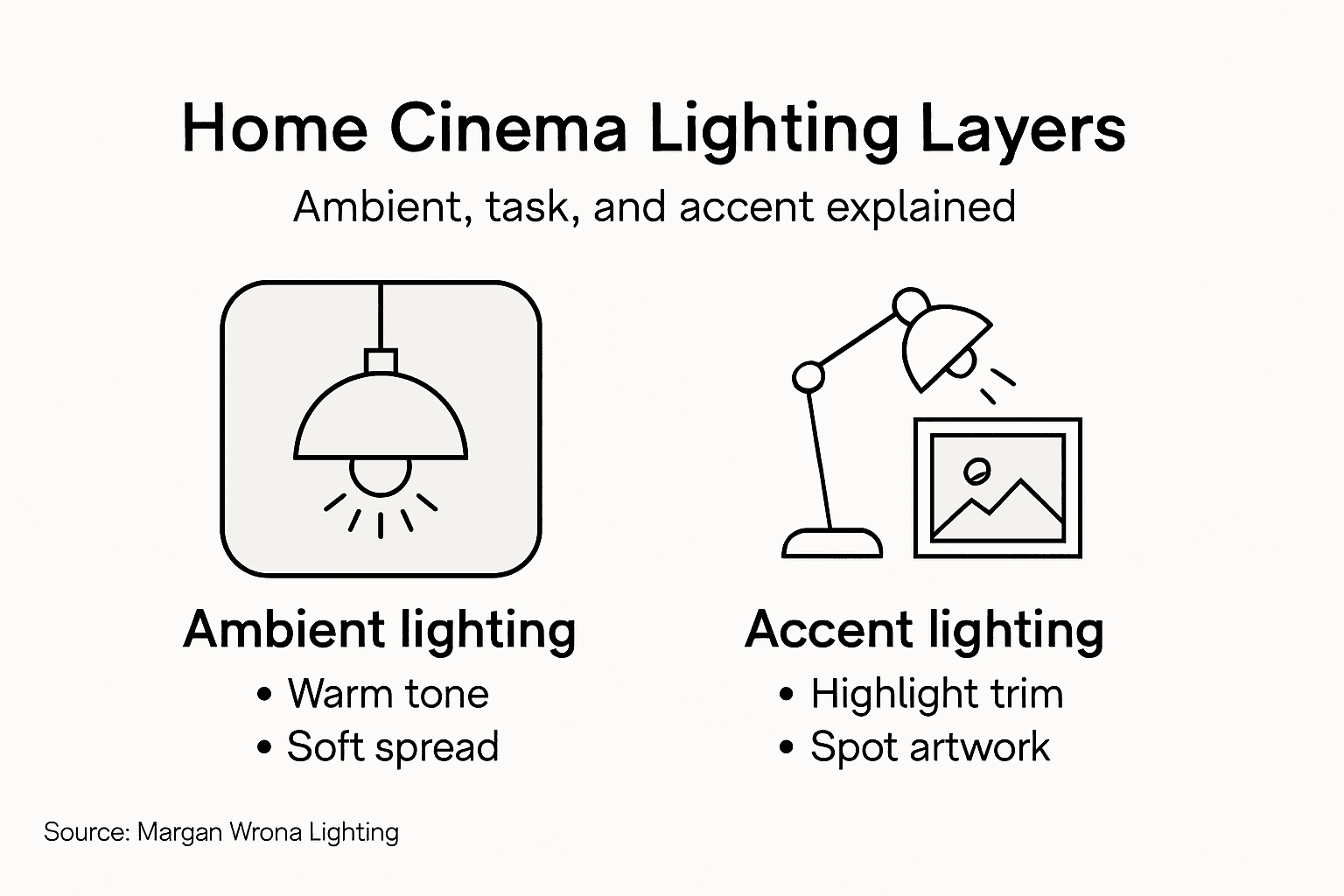
Home cinema rooms typically use three foundational lighting types:
- Ambient lighting – Soft, general illumination that sets the overall mood without overwhelming the screen
- Task lighting – Practical lighting for specific activities like navigating to your seat or accessing refreshments
- Accent lighting – Decorative elements that add visual interest to the room and define architectural features
Common lighting setups for home cinemas balance these layers to create an environment that feels welcoming before the film starts and recedes completely during viewing.
Understanding how each type functions helps you make informed decisions about placement and intensity. What works brilliantly in one corner may create unwanted glare in another.
Here’s a quick summary of the three main types of home cinema lighting and where they work best:
| Lighting Type | Typical Location | Key Benefit |
|---|---|---|
| Ambient lighting | Ceiling or wall fixtures | Overall room mood |
| Task lighting | Seating paths, snack bars | Safe navigation and clarity |
| Accent lighting | Architectural features | Visual depth and atmosphere |
How These Layers Create Visual Depth
Cinema professionals have long understood that lighting techniques create atmosphere and dimension through layering. Your home cinema applies similar principles.
Ambient lighting provides the foundation. This is your room’s base illumination level—warm, diffused, never harsh. It’s what allows someone to safely walk from the door to their seat without tripping.
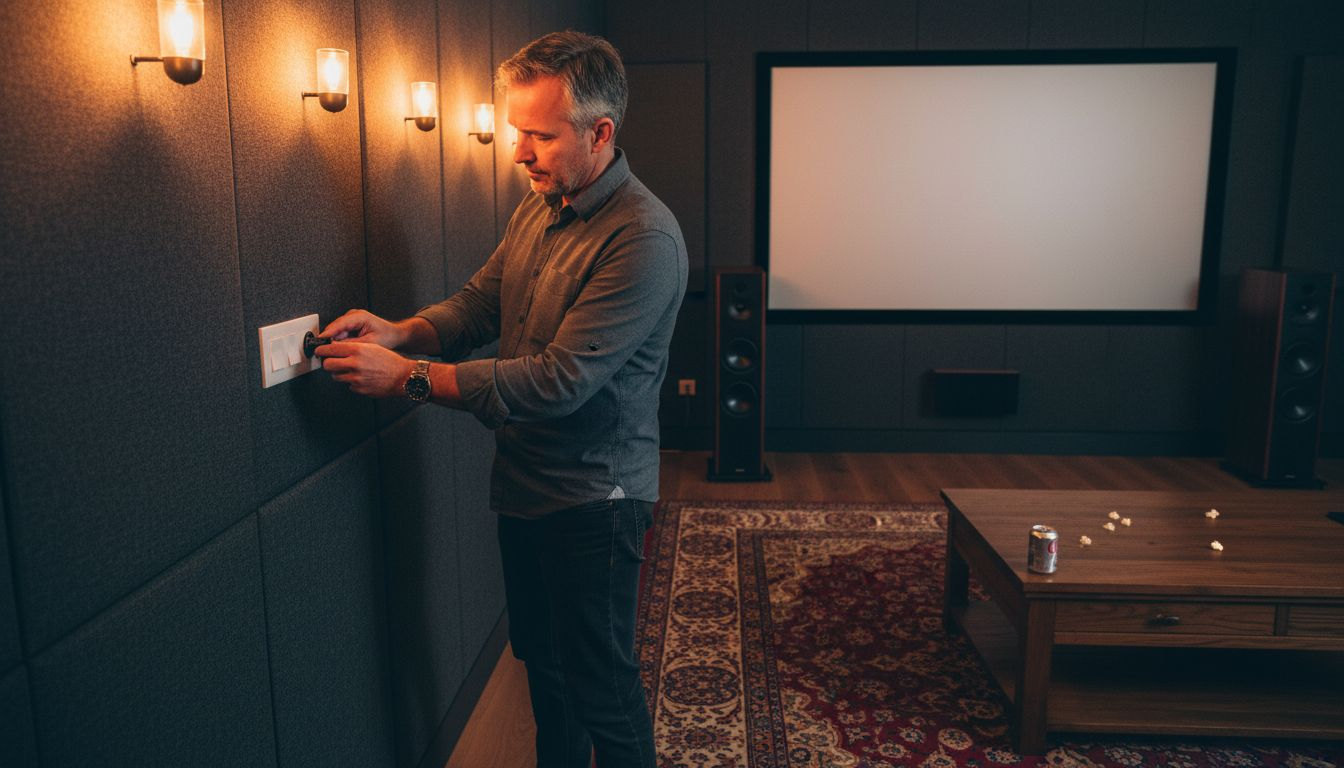
Task lighting targets specific zones. A dimmable wall sconce beside the snack area. LED strips under a side table. These serve practical purposes without spilling unwanted light onto your screen.
Accent lighting transforms the space psychologically. Uplighting behind a floating shelf. Cove lighting along the ceiling perimeter. These elements create depth and draw the eye away from dark, empty corners that can feel oppressive in a viewing room.
The key isn’t adding light everywhere—it’s positioning each light source so it serves its purpose whilst staying invisible during the film.
Colour Temperature Matters
Different lighting types often use different colour temperatures. Ambient lighting typically runs warmer (around 3000K), creating a cosy, inviting atmosphere. This psychological shift prepares your mind for viewing before the film even starts.
Task lighting might be slightly cooler (3500K–4000K) for better visibility when you actually need to see what you’re doing. Accent lighting can vary based on the mood you’re creating and the architectural style of your London home.
The contrast between warm ambient and cooler task areas creates visual interest whilst maintaining comfort. Your eyes don’t strain as they transition from the bright screen back to the room between scenes.
Pro tip: Install dimmers on every lighting circuit in your cinema room, then practice adjusting them before guests arrive so you can confidently dial the lighting to match different films and times of day.
Designing for Ambience, Comfort, and Safety
These three elements work together. Neglect one, and the whole experience falls apart. A beautiful, atmospheric room means nothing if you’re squinting at glare or tripping over unmarked steps.
Designing for all three requires thinking beyond aesthetics. You’re creating an environment where people feel safe, see comfortably, and experience the psychological shift that makes film watching special.
Creating Ambience Through Light Layering
Ambience isn’t about darkness. It’s about intentional lighting that primes your mind for viewing without creating visual chaos.
Start with warm colour temperatures in ambient lighting. Around 3000K feels inviting, almost like candlelight. This warmth matters psychologically. Your brain associates warmer light with relaxation and safety, which is the opposite of theatre lighting in commercial cinemas that often feels cold and industrial.
The layering approach—combining ambient, task, and accent lighting—creates depth that makes the room feel purposeful rather than empty. A darkened cinema room without layered lighting can feel oppressive. With thoughtful accents and gentle ambient glow, it feels intentional.
Comfort: The Often-Forgotten Element
Minimising glare and harsh contrasts reduces eye strain whilst providing enough illumination for safe movement. This balance defines visual comfort.
People forget that comfort extends beyond the film itself. Between scenes, when the screen dims, your eyes need to adjust smoothly back to the room. If the room is pitch black, you’ll experience disorientation and eye fatigue. If it’s too bright, the atmosphere shatters.
Adjusting light levels to suit human vision and psychological needs means understanding that ambience affects mood and overall wellbeing. Dim, warm lighting puts you in a different mental state than bright, cool lighting.
Your guests should feel relaxed before the film even starts, not anxious about navigating an unfamiliar dark space.
Safety: Non-Negotiable Foundation
Safety is where ambience and comfort meet practical necessity. Pathway lighting prevents accidents without disrupting the viewing experience.
Consider these essential safety measures:
- Recessed floor lights along walkways to your seating
- Wall sconces at strategic points for orientation without glare
- Elimination of dark pockets where someone might stumble
- Logical lighting flow from entrance to seating to emergency exits
Safety lighting must feel ambient, not utilitarian. Your guests shouldn’t notice it until they need it.
In a room where you’ve invested in acoustics and video technology, poor lighting safety is an embarrassing oversight. Someone trips, and the entire experience becomes about liability rather than enjoyment.
Design pathways with subtle lighting that guides movement without announcement. Use low-level LED strips under handrails. Position wall lights to illuminate steps without casting harsh shadows that create trip hazards.
Pro tip: Plan your lighting design by walking your cinema room at night with the main lighting off, noting where you instinctively reach out for orientation or slow your pace—these are precisely where your safety lighting should go.
Integrating Smart Controls and Automation
Manual lighting adjustments work fine until they don’t. You’re mid-film, someone enters, the lights flare on. Or you’re settling in for a viewing and fiddling with three different switches trying to find the right mood.
Smart controls eliminate this friction. They let your lighting system adapt to what you’re actually doing without constant adjustment.
What Smart Lighting Control Actually Means
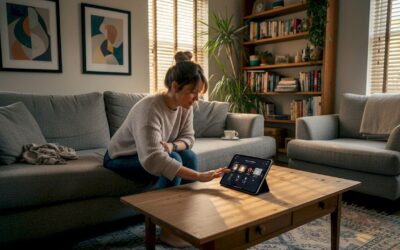
Smart home automation technologies integrate lighting controls that allow you to customise lighting scenes via voice commands, smartphone apps, or automated schedules. This isn’t about luxury—it’s about usability.
Imagine pressing a single button labelled “Film” and watching your room transform. Ambient lighting dims to 15 percent. Accent lights fade softly. The screen becomes your visual centre. This is scene-based lighting, and it works because it removes decision-making from the viewing experience.
Instead of standing in a dark room trying to remember which dimmer controls what, you’ve pre-programmed the perfect balance once. Every time you use that scene, the result is identical.
How Automation Responds to Your Needs
True automation goes beyond preset scenes. IoT-enabled smart home frameworks facilitate centralised control of cinema room lighting, including on/off switching, dimming, and colour adjustments synchronised with media playback.
This means your lighting can respond intelligently to what’s happening in the room:
- Motion sensing – Lights activate at subtle levels when someone enters, then fade when the room settles
- Ambient light detection – The system adjusts brightness based on natural light, maintaining consistent viewing conditions throughout the day
- Media synchronisation – Lighting dims automatically when you press play, then gradually brightens during scene changes
- Voice control – Simply say “cinema mode” instead of reaching for switches in the dark
- Scheduling – Lighting prepares the room before you arrive, or transitions between different moods for family viewing versus solo film watching
Automation should feel invisible. You notice it only when it works perfectly, seamlessly adapting to your needs without thought.
For architect-designed London homes, this level of integration matters. Your lighting system becomes part of the architectural experience rather than an afterthought bolted on later.
The Practical Benefits
Beyond convenience, automation delivers real advantages:
Energy efficiency improves dramatically. Lights don’t stay on unnecessarily because the system knows when the room is occupied and adjusts accordingly. Over months and years, this compounds into meaningful savings.
Consistency matters when you have guests. Your carefully balanced lighting scenes perform identically every time, creating the professional atmosphere you’ve invested in achieving.
Flexibility lets the space evolve. Want different lighting for film watching versus gaming versus simply reading? Switching between pre-set scenes takes seconds.
Pro tip: Start with three core lighting scenes—“Film Mode” for viewing, “Everyday” for general use, and “Entertaining” for when guests arrive—then refine them over a month of actual use before adding complexity like motion sensors or scheduling.
Common Mistakes and Architectural Solutions
Most home cinema lighting problems stem from good intentions applied without forethought. You invest in a beautiful room, then discover the lighting undermines everything you’ve built.
Understanding what goes wrong—and how to avoid it—saves money, time, and frustration later.
The Over-Illumination Problem
The most common mistake is making the room too bright. Homeowners assume more light means better visibility, but it actually destroys the cinematic experience.
When lighting is too intense, several problems emerge simultaneously. Glare washes across your screen, degrading contrast and colour accuracy. Your eyes strain from the brightness differential between the screen and surroundings. The psychological shift into viewing mode never happens because the room feels too lit, too exposed.
Over-illumination causes glare and washes out the screen, destroying the investment you’ve made in picture quality. This is particularly damaging in architect-designed homes where every other system has been optimised with precision.
The solution is counterintuitive: reduce overall ambient light levels dramatically. Aim for 10-20 lux during viewing, not 300. This feels dark at first, but your eyes adapt within minutes.
Placement and Reflection Errors
Poorly positioned lighting creates uneven brightness and distracting reflections. A wall sconce placed directly opposite your screen reflects into your field of view. Recessed downlights cast harsh shadows that make navigation feel awkward.
Architectural solutions prioritise strategic placement:
- Wall sconces positioned at 45-degree angles to avoid direct screen reflection
- Floor-level lighting along pathways rather than overhead fixtures
- Cove lighting along ceiling edges to illuminate the room without direct glare
- Dimmers on every circuit to fine-tune brightness precisely
Placement matters as much as intensity. The right light in the wrong spot creates problems that no amount of adjustment fixes.
Consider sight lines during design. Where do people naturally look? Position accent lighting to guide the eye away from dark corners without placing it in direct view.
Neglecting Control and Flexibility
Users often install lighting that is too bright or lacks flexibility, forcing static setups that work for nothing. A cinema room must adapt to different uses throughout the day.
Without dimmer controls, you’re stuck with single brightness levels. The room works for evening films but feels oppressive at midday. It’s too dark for guests to navigate safely.
Proper architectural solutions integrate controllable lighting at every level:
- Individual circuit control for each lighting type
- Dimmer switches with smooth, reliable operation
- Scene-based automation that combines multiple circuits into preset moods
- Flexible placement allowing you to adjust which lights activate for different uses
A well-designed cinema room should work equally well for a family film at 7 p.m. and casual afternoon conversation.
The Safety Oversight
Dark rooms without safety lighting cause accidents. People trip on steps they can’t see. They bump into architectural features in the blackness.
Architectural solutions embed safety into design rather than treating it separately. Low-level lighting along pathways, strategically placed wall sconces, and subtle orientation cues allow safe movement without disrupting the viewing experience.
Pro tip: Before finalising your lighting design, invite a friend unfamiliar with the room to walk through it in darkness, observing where they instinctively slow down or reach for support—these locations need subtle safety lighting.
The following table compares common home cinema lighting mistakes with their professional solutions:
| Mistake | Negative Outcome | Architectural Solution |
|---|---|---|
| Over-illumination | Glare, loss of image clarity | Use dimmers, lower ambient brightness |
| Poor fixture placement | Distracting reflections | Install lights at correct angles |
| Lack of adjustable controls | Inflexible for different uses | Include scene presets and dimmers |
| Neglecting safety lighting | Trips and falls in darkness | Add integrated path and step lights |
Thoughtful Lighting Design for Home Cinemas
Creating the ideal home cinema environment means balancing ambience, comfort, and safety—challenges clearly outlined in the recent discussion on lighting’s role in enhancing the experience. Homeowners often face difficulties controlling glare and managing light layers that adapt to multiple uses within a single room. Addressing these concerns is essential because the right lighting transforms your viewing space into one that feels inviting and intuitive while protecting your investment in both technology and atmosphere.
At Morgan Wrona, we approach cinema lighting as a considered architectural element integrated seamlessly with your home’s design. Our process begins with consultation and precise system design to ensure your lighting controls provide moments of quiet immersion through carefully layered ambient, task, and accent lighting. Dimmers and smart automation respond naturally to your daily rhythms, easing transitions between film viewing and everyday living. This attention to detail helps maintain visual comfort, reduces eye strain, and ensures safe navigation without distraction.
Explore how intelligent lighting can adapt your home cinema to your lifestyle with reassurance and clarity on Morgan Wrona. If you would like to discuss how this could work in your home, contact us or call 01793 315930.

Frequently Asked Questions
What is the purpose of home cinema lighting?
Home cinema lighting aims to create an immersive environment by controlling ambient light, setting the mood, ensuring safety, managing eye comfort, and allowing the space to function for various uses, all while keeping focus on the screen.
How do the different types of lighting (ambient, task, and accent) work together in a home cinema?
Ambient lighting provides general illumination, task lighting aids in navigation and specific activities, and accent lighting adds visual interest. Together, they create a cohesive atmosphere that enhances the film viewing experience without causing distractions.
Why is colour temperature important in home cinema lighting?
Colour temperature affects mood and comfort. Warmer ambient lighting (around 3000K) creates a cosy atmosphere, while cooler task lighting (3500K-4000K) improves visibility. Balancing these temperatures helps to prepare the viewer psychologically and reduces eye strain during transitions from the screen to the surrounding room.
What are common mistakes in home cinema lighting design?
Common mistakes include over-illumination, poor fixture placement, lack of adjustable controls, and neglecting safety lighting. These errors can lead to glare, accidents, and an uncomfortable viewing environment, thereby diminishing the overall cinema experience.