Automated lighting is frequently misunderstood as a simple convenience feature, something you activate with your phone or voice command. Yet this view overlooks its broader impact on how your home functions day to day. Beyond switching lights on and off remotely, automated systems deliver measurable energy savings, strengthen security, and support your wellbeing through adaptive lighting that mirrors natural daylight. For architect-designed homes, where thoughtful integration matters, understanding these benefits helps you make informed decisions about how lighting can enhance your living environment without compromising aesthetic intent.
Table of Contents
- Key takeaways
- How automated lighting boosts energy efficiency in architect-designed homes
- Security and increased value: added benefits of lighting automation
- Enhancing comfort and wellbeing with adaptive automated lighting
- Limitations and expert tips for successful automated lighting in architect homes
- Discover smart lighting solutions tailored for architect-designed homes
- Frequently asked questions
Key Takeaways
| Point | Details |
|---|---|
| Energy savings potential | Intelligent lighting can cut energy use by 17 to 60 per cent when sensors, scheduling and daylight harvesting work together. |
| Presence sensor priority | Prioritising presence sensors over motion sensors improves reliability by detecting actual occupancy rather than continuous movement. |
| Circadian lighting wellbeing | Circadian lighting adjusts colour temperature and intensity throughout the day to mirror natural daylight, supporting occupant wellbeing. |
| Payback period | Initial costs are typically offset by a payback period of around 18 to 20 months. |
| Security enhancements | Automated lighting strengthens security through motion activated exterior lighting and simulated occupancy when occupants are away. |
How automated lighting boosts energy efficiency in architect-designed homes
Automated lighting reduces energy consumption by responding to occupancy, scheduling, and available daylight. Intelligent systems achieve savings of 17-60% when sensors, schedules, and daylight harvesting work together. For architect-designed homes with generous glazing and carefully planned natural light, this integration becomes essential rather than optional.
Daylight harvesting adjusts artificial lighting based on how much natural light enters a room. Without this integration, electric lighting can consume up to 300% more energy than necessary. Your home’s large windows and skylights already provide substantial illumination during daylight hours. Automated systems recognise this and dim or switch off electric lights accordingly, preventing wasted energy whilst maintaining the visual comfort you expect.
Occupancy detection adds another layer of efficiency. Presence sensors detect when someone enters or remains in a room, switching lights on only when needed. Unlike motion sensors that require continuous movement, presence sensors detect subtle activity like reading or working at a desk. This distinction matters in architect-designed homes where rooms serve multiple purposes and occupants may remain still for extended periods.
Typical energy savings by system type:
| System configuration | Average savings |
|---|---|
| Basic scheduling only | 15-20% |
| Occupancy sensors only | 20-30% |
| Daylight integration only | 25-35% |
| Combined optimised system | 40-60% |
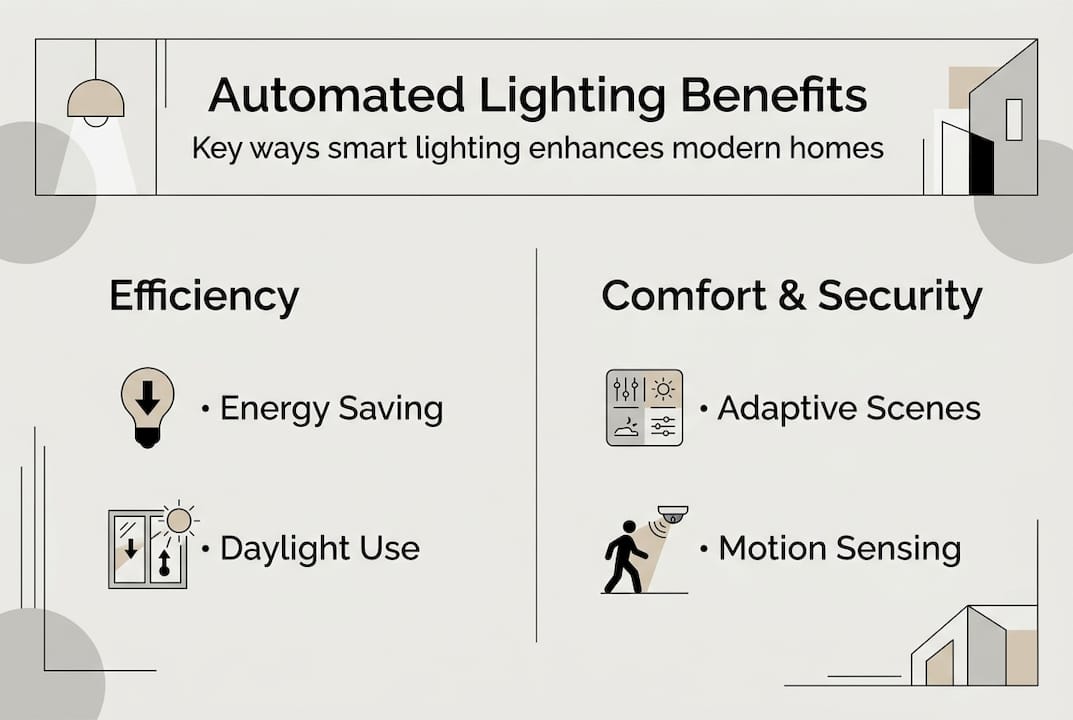
Scheduling complements sensor-based control by aligning lighting with your daily routines. Morning routines, evening relaxation, and overnight security lighting follow predictable patterns. Programming these sequences eliminates unnecessary lighting during unoccupied hours whilst ensuring rooms are properly lit when you need them.
Circadian lighting introduces complexity but delivers non-energy benefits alongside efficiency gains. These systems adjust colour temperature and intensity throughout the day, mimicking natural daylight progression. Whilst this adds programming and hardware requirements, the wellbeing benefits often justify the additional investment for homeowners prioritising comfort alongside efficiency.
Pro Tip: When planning smart home lighting systems, prioritise daylight sensors in rooms with substantial glazing. These deliver the highest energy savings in architect-designed homes where natural light is abundant.
Security and increased value: added benefits of lighting automation
Automated lighting strengthens home security through motion-activated deterrence and simulated occupancy patterns. Security features and property value enhancement make automated lighting attractive beyond energy considerations. For architect-designed properties, these benefits must integrate sensitively with design intent rather than compromise aesthetic quality.
Motion-activated exterior lighting deters intruders by illuminating approaches and entry points when movement is detected. The sudden activation signals occupancy and removes the cover of darkness. In architect-designed homes, this functionality must balance security with architectural sensitivity. Fixtures should integrate with the building’s design language rather than appear as obvious security additions.
Simulated occupancy provides security when you’re away. The system replicates your typical lighting patterns, switching lights on and off in sequences that suggest normal activity. This creates the impression of occupancy without requiring manual intervention or neighbour assistance. For extended absences, this automated presence offers reassurance that your property appears inhabited.
Security features in automated lighting:
- Perimeter lighting activates when movement detected near entry points
- Randomised timing prevents predictable patterns that signal absence
- Integration with home control systems coordinates lighting with other security measures
- Remote monitoring allows you to check and adjust lighting from anywhere
Property value considerations matter for architect-designed homes. Automated lighting systems signal modernity and thoughtful integration, appealing to buyers who value technology that enhances daily living. The system becomes part of the property’s narrative, demonstrating attention to how the home functions rather than just how it appears.
Privacy considerations require careful planning. Automated lighting should enhance security without creating excessive light pollution or revealing interior activity to observers. Thoughtful programming ensures lights activate appropriately without broadcasting your movements or routines to neighbours and passersby.
Pro Tip: Programme security lighting to activate at varied intervals rather than fixed times. This unpredictability makes simulated occupancy more convincing whilst maintaining the security benefits you need.
Enhancing comfort and wellbeing with adaptive automated lighting
Automated lighting improves occupant comfort, mood, and sleep quality through circadian rhythm lighting and adaptive ambience. Research demonstrates improved wellbeing when lighting mimics natural daylight patterns, supporting hormonal balance throughout the day. For architect-designed homes where natural light already plays a significant role, automated systems extend this benefit into evening hours and spaces with limited daylight access.
Circadian lighting adjusts colour temperature and intensity to match natural daylight progression. Morning light begins cool and gradually warms through midday, then shifts to warmer tones as evening approaches. This progression supports your body’s natural rhythms, promoting alertness during active hours and preparing you for rest as day transitions to night.

Adaptive scene setting enhances daily comfort by matching lighting to activities. Reading requires different illumination than dining or relaxing. Automated systems recall these preferences and apply them consistently, removing the need to manually adjust multiple fixtures. Your lighting workflow becomes intuitive, responding to how you use each space throughout the day.
LED lighting combined with daylight integration outperforms traditional fluorescent in wellbeing impact. LEDs offer precise colour temperature control and dimming capabilities that fluorescent technology cannot match. This control allows systems to replicate natural daylight characteristics more accurately, delivering greater wellbeing benefits whilst consuming less energy.
Implementing circadian lighting effectively:
- Map your daily routines to identify lighting needs at different times
- Programme morning sequences with cooler colour temperatures to support alertness
- Transition to warmer tones in evening to prepare for rest
- Integrate daylight sensors to maintain natural light priority
- Adjust intensity levels to match activity requirements in each space
Common pitfalls include neglecting daylight sensors and over-relying on electric lighting. Without daylight integration, automated systems may illuminate rooms unnecessarily during daylight hours, increasing energy consumption rather than reducing it. This defeats the efficiency purpose whilst potentially disrupting the natural light qualities that attracted you to your architect-designed home.
“System customisation aligned with occupant lifestyle delivers optimal benefits. Generic programming rarely accounts for the specific patterns and preferences that make automated lighting valuable in daily use.”
Expert guidance emphasises personalisation over standard configurations. Your routines, room usage patterns, and comfort preferences differ from generic assumptions. Effective automated lighting adapts to these individual factors rather than imposing predetermined sequences that may not suit your lifestyle.
Limitations and expert tips for successful automated lighting in architect homes
Automated lighting presents challenges including sensor reliability, connectivity dependence, retrofit compatibility, and upfront costs. Understanding these limitations helps you plan effectively and avoid common frustrations that undermine system benefits.
Motion sensors may incorrectly switch off lights when occupants remain stationary. This common limitation causes discomfort and frustration, particularly in spaces where you read, work, or relax without constant movement. Presence sensors address this by detecting subtle activity and maintaining illumination as long as someone occupies the room.
Connectivity outages can disable systems entirely. When your network fails, automated controls may become inaccessible, leaving you unable to operate lighting through normal interfaces. Planning for this scenario requires fallback options, whether manual overrides or backup connectivity, ensuring you maintain basic lighting control during outages.
Retrofitting older homes presents compatibility challenges. Existing wiring may not support modern sensors and controls without modification. Architectural features that define your home’s character can complicate installation, requiring creative solutions that preserve design intent whilst accommodating new technology. Expert planning identifies these constraints early, developing approaches that work within your home’s existing structure.
Comparing sensor types for reliability:
| Sensor type | Detection method | Best for | Limitation |
|---|---|---|---|
| Motion sensor | Movement required | Corridors, entries | Misses stationary occupants |
| Presence sensor | Subtle activity | Living spaces, studies | Higher initial cost |
| Daylight sensor | Ambient light levels | Rooms with glazing | Requires calibration |
High upfront costs concern many homeowners. Automated lighting systems require investment in sensors, controls, wiring modifications, and professional installation. However, typical payback periods of 18-20 months through energy savings make this investment financially sound for most architect-designed homes where lighting represents a substantial portion of electricity consumption.
Expert recommendations for successful implementation:
- Prioritise presence sensors over motion sensors in primary living spaces
- Integrate daylight harvesting in rooms with substantial glazing
- Plan fallback controls for connectivity outages
- Budget for professional design and commissioning
- Schedule periodic system reviews to optimise performance
Pro Tip: Commission your automated lighting system properly. Initial programming rarely accounts for all usage patterns. Allow time for adjustments based on actual living experience, refining settings until the system responds naturally to your daily routines.
Compatibility between different manufacturers’ products can limit flexibility. Proprietary systems may lock you into specific brands for future additions or replacements. Open protocols offer greater flexibility but may require more complex integration work. Your lighting design workflow should consider long-term system evolution, not just initial installation.
Maintenance requirements vary by system complexity. Simple scheduled lighting needs minimal attention, whilst sophisticated circadian systems benefit from periodic review and adjustment. Understanding these ongoing requirements helps you plan for system longevity rather than treating automated lighting as a set-and-forget installation.
Professional guidance proves valuable throughout planning, installation, and commissioning. Home automation expertise ensures your system integrates properly with architectural design whilst delivering the functionality you need. This consultation identifies potential issues before they become problems, saving time and expense during implementation.
Discover smart lighting solutions tailored for architect-designed homes
Automated lighting transforms how your home responds to daily life, delivering energy efficiency, security, and wellbeing benefits when designed properly. For architect-designed properties where integration matters, professional guidance ensures technology enhances rather than compromises your living environment.
Morgan Wrona specialises in lighting automation for architect-designed homes, creating systems that adapt seamlessly to your lifestyle whilst respecting design intent. Our approach prioritises consultation and customisation, ensuring your automated lighting delivers the benefits you need without unnecessary complexity. We work closely with homeowners to understand daily routines, architectural features, and comfort preferences, then design systems that respond naturally to how you live.
Explore our home automation solutions to discover how intelligent lighting can enhance your property. Our smart home lighting services cover consultation, system design, installation, and ongoing support. If you would like to discuss how automated lighting could work in your home, call 01793 315930 or download our brochure.
Frequently asked questions
What is automated lighting and how does it work?
Automated lighting uses sensors, schedules, and controls to operate lighting with minimal manual input. Presence sensors detect occupancy and switch lights on when someone enters a room, whilst daylight sensors measure available natural light and adjust artificial lighting accordingly. These components work together through a central control system that manages timing, intensity, and colour temperature based on programmed preferences and real-time conditions.
How does automated lighting improve energy efficiency?
Energy savings come from using light only when needed, dimming when daylight is sufficient, and optimising schedules around your routines. Daylight sensors dramatically reduce reliance on electric lighting by recognising when natural light provides adequate illumination. Occupancy detection ensures lights switch off in unoccupied rooms rather than running unnecessarily. Combined, these features typically reduce lighting energy consumption by 17-60% compared to manual control.
Can automated lighting be retrofitted in architect-designed homes?
Retrofitting may face wiring, compatibility, and aesthetic challenges that require careful planning. Existing electrical infrastructure might not support modern sensors and controls without modification. Architectural features that define your home’s character can complicate installation, requiring creative approaches that preserve design intent. Professional lighting design guidance ensures functional and discreet integration without compromising the qualities that make your home distinctive.
What are common limitations of automated lighting systems?
Motion sensors may miss stationary occupants, causing lights to switch off unexpectedly when you’re reading or working without constant movement. Systems depend on reliable connectivity and power, with outages affecting performance and accessibility. Upfront costs and retrofit compatibility can present barriers without expert planning to identify solutions that work within your budget and existing structure. Presence sensors address the stationary occupant issue, whilst proper system design includes fallback controls for connectivity problems.