Many assume smart home lighting means complicated gadgets that disrupt design; in reality, these systems blend invisibly enhancing living experience. For homeowners of architecturally designed properties, intelligent lighting offers a way to elevate everyday life without compromising aesthetic intent. This article explores the technology, benefits, integration strategies, common myths, and practical implementation steps to help you make informed decisions about smart lighting in your home.
Table of Contents
- Introduction To Smart Home Lighting
- How Smart Lighting Technology Works
- Automation And Energy Efficiency Benefits
Key takeaways
| Point | Details |
|---|---|
| Integration and design sensitivity | Smart lighting combines intelligent control with design awareness, preserving architectural character. |
| Energy efficiency and automation | Automated systems reduce energy consumption significantly while enhancing daily convenience. |
| Professional consultation matters | Selecting the right system requires expert guidance, tailored design, and ongoing support. |
| Myth versus reality | Smart lighting integrates subtly and delivers long-term value despite misconceptions about complexity. |
Introduction to smart home lighting
Smart home lighting represents a shift from static, manually controlled fixtures to intelligent systems that respond to your lifestyle. Unlike traditional lighting, which relies on fixed switches and timers, smart systems connect light fixtures to centralised controls using wireless protocols like Zigbee, Wi-Fi, and Bluetooth. This connectivity allows remote management, automated adjustments, and adaptive responses to occupancy and ambient light conditions.
For architecturally designed homes, this technology offers unique advantages. Bespoke properties often feature complex spatial layouts, varied ceiling heights, and carefully considered sight lines. Smart lighting can address these nuances by providing granular control over individual zones, creating layered lighting schemes that enhance architectural features, and adapting to how you move through your home throughout the day.
Core functions of smart lighting include:
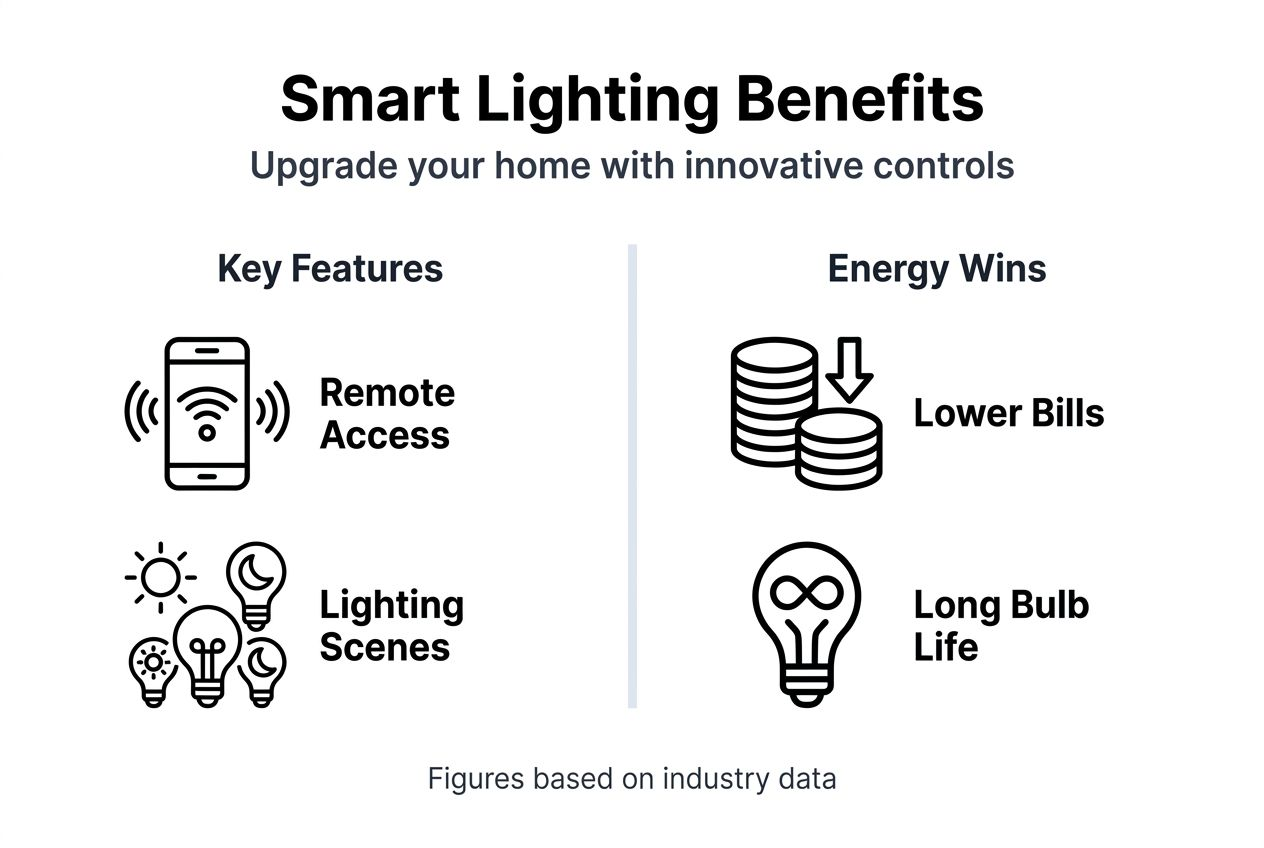
- Remote control via smartphone apps or voice assistants, letting you adjust lighting from anywhere
- Automated routines that align lighting with daily activities, such as gradual morning brightening or evening dimming
- Adaptive responses to environmental cues, including occupancy sensors and daylight harvesting
- Scene programming that recalls specific lighting configurations for entertaining, reading, or relaxation
These capabilities allow you to transform how light shapes your living spaces, making everyday interactions more intuitive whilst preserving the architectural integrity your home was designed to express.
How smart lighting technology works
Understanding the technical foundation helps you make informed choices about which systems suit your home. Smart lighting relies on wireless communication protocols to connect devices, with each protocol offering distinct characteristics.
Zigbee uses a mesh network enhancing reliability over Wi-Fi for large homes by 25%. In a mesh network, each device acts as a signal repeater, extending coverage throughout your property without requiring additional infrastructure. Wi-Fi connects directly to your home network, offering broad compatibility but potentially straining bandwidth in larger installations. Bluetooth provides simple pairing for individual fixtures or small zones, ideal for retrofit situations where whole-home integration isn’t required.
| Protocol | Best For | Range | Reliability |
|---|---|---|---|
| Zigbee | Whole-home systems in large properties | Extended via mesh | High in complex layouts |
| Wi-Fi | Single-room or moderate installations | Standard router coverage | Dependent on network quality |
| Bluetooth | Individual fixtures or small zones | Limited to 10 metres | Suitable for simple setups |
Devices within smart lighting systems include:
- Smart bulbs that replace existing lamps and offer colour, dimming, and scheduling
- Smart switches that control existing fixtures whilst providing app and voice integration
- Hubs that coordinate communication between devices and enable advanced automation
- Sensors that detect occupancy, ambient light levels, and environmental conditions
Control options vary to suit different preferences. Smartphone apps provide detailed configuration and remote access. Voice assistants like Amazon Alexa or Google Assistant offer hands-free operation. Physical smart switches maintain tactile familiarity whilst integrating with the broader system. In design-sensitive homes, physical switches serve as essential backups, ensuring guests and family members can control lighting intuitively without needing app access.
Selecting the appropriate protocol and device mix depends on your property’s size, architectural complexity, and how you prefer to interact with technology. Professional consultation helps design systems that balance technical performance with your daily routines and aesthetic expectations.
Automation and energy efficiency benefits
Automation transforms lighting from a manual task into an intelligent background service that adapts to your presence and needs. Occupancy sensors detect when rooms are in use, automatically illuminating spaces as you enter and switching off lights when areas remain vacant. Ambient light sensors monitor natural daylight, adjusting artificial lighting levels to maintain consistent illumination whilst minimising energy waste.
Automation reduces inactive use by up to 40% compared to manual control. This occurs because people often forget to switch off lights in infrequently used rooms, hallways, or secondary spaces. Smart systems eliminate this oversight, ensuring lights operate only when required.
Energy savings extend beyond automation. Smart lighting reduces consumption by up to 90% compared to traditional incandescent lighting. This dramatic reduction stems from LED technology combined with intelligent dimming and scheduling. LEDs consume a fraction of the power used by incandescent or halogen bulbs, and smart controls ensure lights never burn brighter or longer than necessary.
Programmable scenes enhance daily convenience by recalling specific lighting configurations with a single command. You might create a
Recommended
- Home Lighting Workflow Guide: Achieve Seamless Ambience
- Role of architectural lighting: 40% less eye strain proven
- Lighting design workflow guide for UK architect homes
- Lighting Control Workflow for Effortless Home Ambience
- 6 Essential Plant Care Tips for Architects’ Design Success
FREQUENTLY ASKED QUESTIONS
WHAT IS SMART HOME LIGHTING IN AN ARCHITECTURALLY DESIGNED HOME?
Smart home lighting is an intelligent system that controls light fixtures through wireless technology, automation, and centralised settings. In an architecturally designed home, it helps enhance comfort, usability, and atmosphere whilst respecting the property’s layout, materials, and visual character.
HOW DOES SMART LIGHTING DIFFER FROM TRADITIONAL HOME LIGHTING?
Traditional lighting depends on fixed switches and manual control, whereas smart lighting responds dynamically to your routines, occupancy, and daylight levels. This allows more precise control over brightness, timing, and mood without relying on static lighting arrangements.
CAN SMART LIGHTING WORK WITHOUT AFFECTING THE DESIGN OF MY HOME?
Yes. Smart lighting systems can be integrated discreetly through hidden sensors, well-designed switches, and carefully selected fittings that align with the architecture of your home. When planned properly, the technology supports the design rather than distracting from it.
WHAT ARE THE MAIN BENEFITS OF SMART LIGHTING FOR DAILY LIVING?
Smart lighting improves convenience, comfort, and energy efficiency. It can automate routines, adjust to natural light, create scenes for different activities, and reduce the need for constant manual switching, making everyday living more intuitive.
WHICH WIRELESS PROTOCOLS ARE COMMONLY USED IN SMART LIGHTING SYSTEMS?
Common smart lighting protocols include Zigbee, Wi-Fi, and Bluetooth. Zigbee is often well suited to larger homes because its mesh network improves reliability, while Wi-Fi is useful for moderate installations and Bluetooth works well for smaller or simpler setups.
WHAT DEVICES ARE INCLUDED IN A SMART LIGHTING SYSTEM?
A smart lighting system may include smart bulbs, smart switches, central hubs, occupancy sensors, and daylight sensors. These components work together to provide automation, remote access, scene setting, and responsive lighting adjustments throughout the home.
HOW DOES SMART LIGHTING HELP WITH ENERGY EFFICIENCY?
Smart lighting improves energy efficiency by combining LED technology with automation features such as dimming, scheduling, occupancy sensing, and daylight harvesting. This helps ensure lights are only used when needed and only at the required brightness level.
CAN SMART LIGHTING BE CONTROLLED IN DIFFERENT WAYS?
Yes. Smart lighting can usually be controlled through smartphone apps, voice assistants, physical smart switches, and pre-programmed scenes. This flexibility allows homeowners to choose the control methods that best suit their routines and preferences.
WHY IS PROFESSIONAL CONSULTATION IMPORTANT WHEN PLANNING SMART LIGHTING?
Professional consultation helps ensure the system matches your home’s size, layout, architectural details, and daily use patterns. It also reduces the risk of choosing incompatible devices or creating a scheme that feels overly complex or visually intrusive.
IS SMART LIGHTING ONLY SUITABLE FOR NEW-BUILD HOMES?
No. Smart lighting can be installed in both new-build and existing homes. Some systems are especially suitable for retrofitting because they use wireless communication and can work with existing circuits, while more advanced schemes can be designed into new projects from the outset.