The most impressive home cinemas are virtually invisible. That is the counterintuitive truth that shapes how the finest architect-designed homes approach audiovisual integration today. Rather than dominating a room with screens, cables, and speaker towers, a well-considered integrated home cinema disappears into the architecture, leaving only the experience. This guide covers everything you need to understand: what integrated home cinema actually means, how it differs from a dedicated cinema room, which technologies make it possible, and how to plan a project that respects both your home’s design and your expectations for performance.
Table of Contents
- What is integrated home cinema?
- How does integrated home cinema differ from dedicated cinema rooms?
- Technologies shaping integrated home cinema
- Performance considerations: sound and vision in architectural spaces
- Practical steps for creating your integrated home cinema
- How we can help you realise your integrated home cinema
- Frequently asked questions
Key Takeaways
| Point | Details |
|---|---|
| Seamless design integration | An integrated home cinema blends technology with architecture for stunning yet discreet results. |
| Smart technology synergy | Invisible speakers and advanced controls deliver high performance without intruding on your living space. |
| Performance trade-offs | Integrated systems offer impressive sound and visuals but may not reach the immersion level of dedicated cinema rooms. |
| Early planning is essential | Involving your architect and AV specialist early ensures the best balance of design and audio-visual quality. |
What is integrated home cinema?
An integrated home cinema is a system where all audiovisual components, including speakers, screens, wiring, and controls, are built into the fabric of a room rather than placed within it. The distinction matters. A television mounted on a wall is not integration. Integration means the room itself becomes the cinema, with no visible hardware interrupting the space.
The key components of a truly integrated system include:
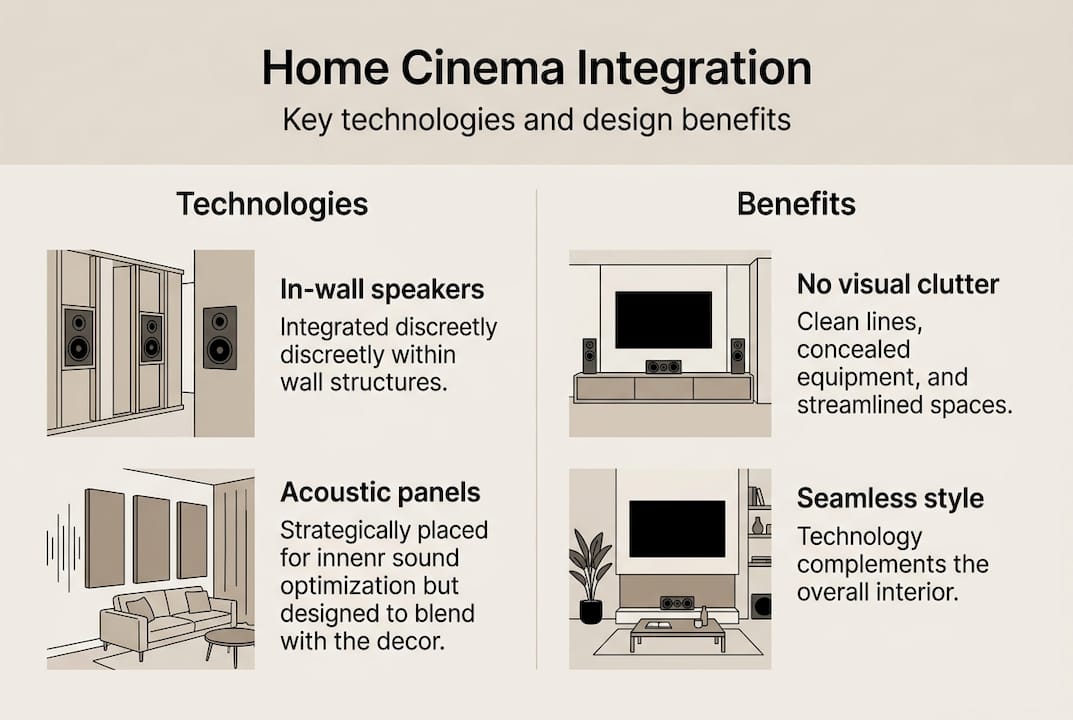
- Invisible or in-wall speakers that sit flush with or behind plaster, producing sound without any visible driver or grille
- Motorised screens or projectors that retract into ceilings or cabinetry when not in use
- Concealed wiring routed through walls and floors during construction or careful renovation
- Smart control systems that manage audio, video, and lighting from a single interface
As invisible speakers provide clarity and seamless integration, the result is a living space that functions beautifully whether the system is active or not. Control platforms such as Control4 and Lutron allow every element, from screen position to room lighting, to respond to a single command.
The goal of integration is not to hide technology. It is to make technology irrelevant to the experience of the room.
This is fundamentally different from simply concealing equipment. A drop-down projector screen, for example, is concealed but not integrated. A tailored home cinema experience goes further, shaping the room so that every surface, material, and system works together.
How does integrated home cinema differ from dedicated cinema rooms?
Now that we have established what integrated home cinema is, it is important to see how it stands apart from traditional approaches. A dedicated cinema room is a space built entirely around the viewing experience. Acoustic panels line the walls, seating is fixed and tiered, lighting is controlled to near-blackout levels, and every decision serves one purpose: peak cinematic immersion.
Integrated home cinema takes a different position. The room serves multiple functions. It might be a living room in the morning, a space for conversation in the evening, and a cinema at night. That flexibility is its strength, and also where some trade-offs appear.
| Feature | Integrated home cinema | Dedicated cinema room |
|---|---|---|
| Room function | Multipurpose | Single purpose |
| Acoustic performance | Good, with careful planning | Excellent, purpose-built |
| Visual flexibility | High | Low |
| Design integration | Seamless | Functional |
| Daily usability | Very high | Limited |
As dedicated rooms offer superior immersion and controlled lighting, they do lack the flexibility of integrated spaces. For many homeowners, particularly those with open-plan living areas or properties where every room carries architectural weight, a dedicated cinema room is simply not practical or desirable.
Pro Tip: Before deciding between the two approaches, consider how you actually use your home day to day. If the space needs to serve multiple purposes, integration will almost always suit your lifestyle better. Our smart cinema systems guide explores this in more detail, and design-led cinema concepts can help you see what is possible within your existing architecture. For those in the early stages of a build, integrating systems into your building project from the outset makes a significant difference to the final result.
Technologies shaping integrated home cinema
With those distinctions clear, let us look at the technologies that enable seamless integration. The components available today are considerably more refined than they were even five years ago, and the gap between visible and invisible performance has narrowed substantially.
Speakers are where integration begins. Planar magnetic speakers use a thin membrane rather than a traditional cone driver, producing a wide, even sound field from a very slim profile. Brands such as Wisdom Audio and Sonance prioritise clarity while remaining unobtrusive, sitting flush within walls or ceilings without compromising the room’s finish.
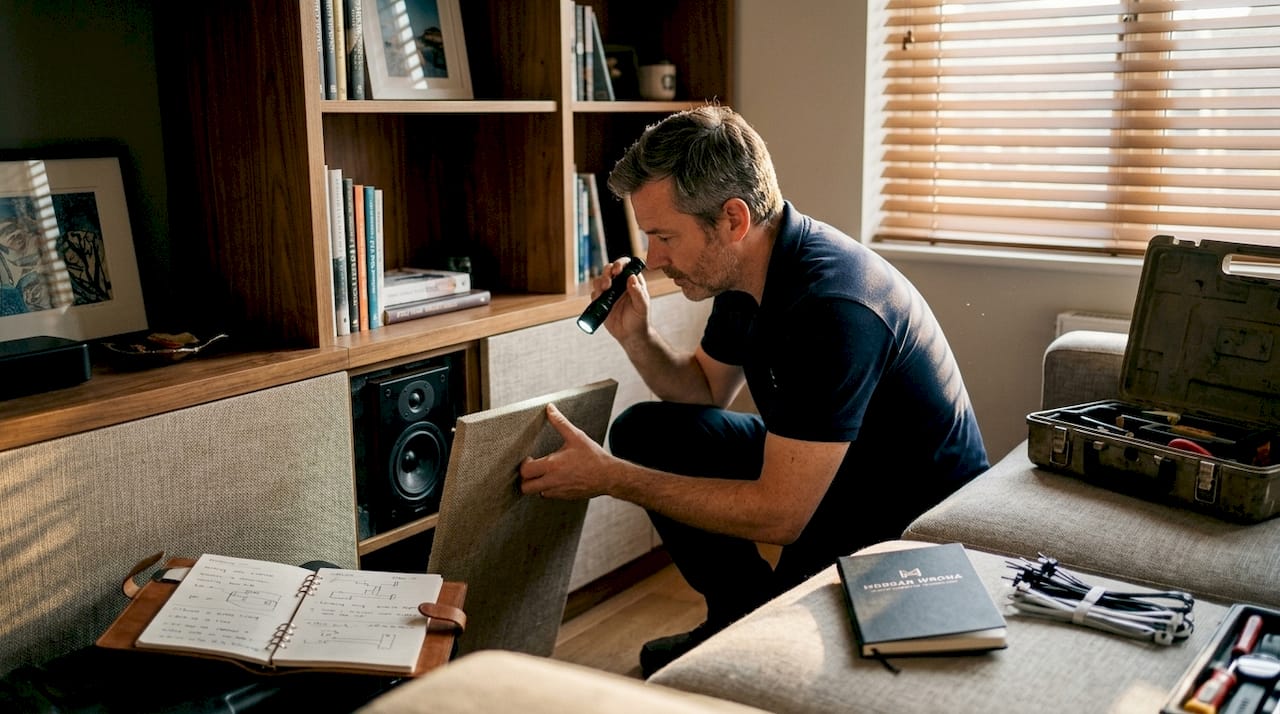
Acoustic treatments have also evolved. Panels that absorb or diffuse sound can be upholstered in fabric, covered in artwork, or finished to match wall surfaces. They perform a technical function without announcing it.
Smart control ecosystems such as Control4 and Lutron provide seamless control over audio, visuals, and lighting from a single app or keypad. When you select a film, the lights dim, the screen descends, and the sound system activates. The experience feels effortless because the complexity is handled behind the scenes.
| Technology | Function | Design benefit |
|---|---|---|
| In-wall/invisible speakers | Full-range audio | No visible hardware |
| Planar magnetic speakers | Wide sound dispersion | Ultra-slim profile |
| Motorised projector/screen | Image delivery | Retracts when not in use |
| Acoustic panels | Sound absorption/diffusion | Finished as décor |
| Control4 / Lutron | System automation | Single-point control |
The impact of home cinema automation on how a space feels day to day is considerable. Equally, lighting within home cinemas plays a role that goes well beyond simply dimming the room.
Performance considerations: sound and vision in architectural spaces
Equipped with an understanding of what is available, it is time to evaluate performance within real-world homes. Integrated systems perform exceptionally well in most settings, but architectural context matters.
Open-plan spaces with glass walls, stone floors, or high ceilings present acoustic challenges. Hard surfaces reflect sound rather than absorbing it, which can reduce clarity and create an uneven listening experience. The solution is not to avoid integration but to plan for it carefully.
Key performance considerations include:
- Speaker placement relative to seating positions and room boundaries
- Acoustic treatment of reflective surfaces, even subtly, through rugs, soft furnishings, or dedicated panels
- Screen size and projector throw distance relative to viewing positions
- Ambient light control to maintain image quality at different times of day
Research shows that soundbars outperform discrete systems by 15 to 25 per cent in reflective small rooms, but lag behind in large open-plan spaces where a properly specified integrated system comes into its own. On the visual side, integrated rooms typically achieve 30-degree viewing angles, which suits multi-use spaces well, though this is a step down from the THX standards found in purpose-built environments.
Pro Tip: Raise acoustics with your architect and AV specialist at the earliest possible stage. Decisions made during the structural phase, such as wall construction, floor finishes, and ceiling height, have a direct bearing on how the system will perform. Revisiting these after completion is costly and disruptive.
Thoughtful lighting automation transforms how a room performs for both viewing and everyday use. A seamless lighting workflow ensures the space adapts naturally to whatever is happening within it. For further context on how design and usability intersect in integrated environments, smart home design principles offer a useful reference point.
Practical steps for creating your integrated home cinema
Once you know what to expect from an integrated setup, you can start planning your own project. The process is straightforward when approached in the right order.
- Assess your lifestyle and space. Which rooms are candidates? How are they used throughout the day? What level of cinematic performance do you want, and how does that sit alongside other uses of the space?
- Consult your architect and AV specialist together. The earlier these conversations happen, the more options you have. Structural decisions affect acoustic performance, cable routing, and equipment placement.
- Prioritise invisible technology. As fully integrated speakers and panels outperform drop-down screens in clarity and seamlessness, the investment in proper integration pays back in both performance and aesthetics.
- Specify your control system. Decide how you want to interact with the system. A well-configured control platform means the technology serves you intuitively, without requiring technical knowledge to operate.
- Plan for acoustics from the outset. Identify which surfaces will need treatment and how that treatment will be finished to complement the room.
- Future-proof with modular components. Choose systems that can be updated or expanded without requiring structural work. Technology evolves, and your system should be able to evolve with it.
Common pitfalls include leaving AV planning too late in a build programme, underestimating the effect of natural light on screen visibility, and allowing visible cable management to compromise an otherwise considered interior. Home automation explained covers how these systems fit within a broader smart home context, and lighting control in home cinemas addresses one of the most frequently overlooked aspects of the planning process.
Pro Tip: Involve your interior designer in the AV specification process. The best results come when acoustic panels, speaker positions, and screen locations are considered as part of the room’s design, not added afterwards.
How we can help you realise your integrated home cinema
At Morgan Wrona, we work with homeowners and their design teams to plan and install integrated home cinema systems that respect the architecture of the property and perform to a high standard in daily use. Our approach begins with a detailed consultation, moves through system design and specification, and continues through installation, commissioning, and aftercare.

We understand that a home of this calibre deserves a considered approach, one where every component is chosen for both its performance and its fit within the space. If you would like to explore what an integrated home cinema could look like in your home, we would be glad to discuss it. Contact us, call [01793 315930](tel:01793 315930), or download our brochure to see examples of our work.
Frequently asked questions
What are invisible speakers and how do they work in home cinema?
Invisible speakers are installed within walls or ceilings and use vibrational technology to produce sound that fills the room without any visible hardware. They provide clarity and seamless integration, making them well suited to spaces where design cannot be compromised.
Can integrated home cinema systems match the quality of dedicated cinema rooms?
Integrated setups offer flexibility but may not achieve the absolute acoustic isolation or peak dynamic range of a purpose-built room. For most homes, however, the performance of a well-specified integrated system is more than sufficient.
Are integrated home cinemas suitable for open-plan or glass-heavy spaces?
Yes, but they require careful acoustic planning. Soundbars show advantages in small reflective rooms while integrated solutions need precise speaker placement and surface treatment to perform well in larger, more open environments.
How important is lighting control in integrated home cinema?
Lighting control is fundamental. It shapes the ambience of the room, protects image quality by managing ambient light, and allows the space to transition naturally between different uses throughout the day. Smart lighting controls are a standard part of any well-considered integrated system.