A home cinema is one of the most considered investments you can make in your property. Yet many homeowners assume the result depends almost entirely on buying the right equipment. In reality, the room itself shapes the experience just as much as the screen or speakers. Architect-designed homes offer a genuine advantage here, because thoughtful spatial planning and structural integrity give you a foundation that most properties simply cannot match. This guide walks through the key decisions, from room geometry and acoustic principles to video choice and smart integration, so you can approach the process with confidence and clarity.
Table of Contents
- Understanding the essentials of home cinema design
- Architectural considerations: Designing for your space
- Choosing the right video solution: Projector or TV?
- Audio, lighting and integration: Bringing your cinema to life
- Why real home cinema success requires collaboration from day one
- Elevate your home with expert automation and design support
- Frequently asked questions
Key Takeaways
| Point | Details |
|---|---|
| Room size and shape matter | The dimensions and geometry of your cinema space are critical for achieving the best sound and picture quality. |
| Choose video tech wisely | Projectors work best for dark, large rooms, while OLED TVs excel in bright spaces for striking visuals. |
| Seamless integration is key | Collaborating with architects and AV experts allows for discreet, harmonious design and superior performance. |
| Lighting sets the mood | Thoughtfully layered lighting enhances both the cinema experience and the room’s everyday ambience. |
| Early planning saves cost | Involving relevant specialists early ensures a truly bespoke solution with fewer compromises and greater enjoyment. |
Understanding the essentials of home cinema design
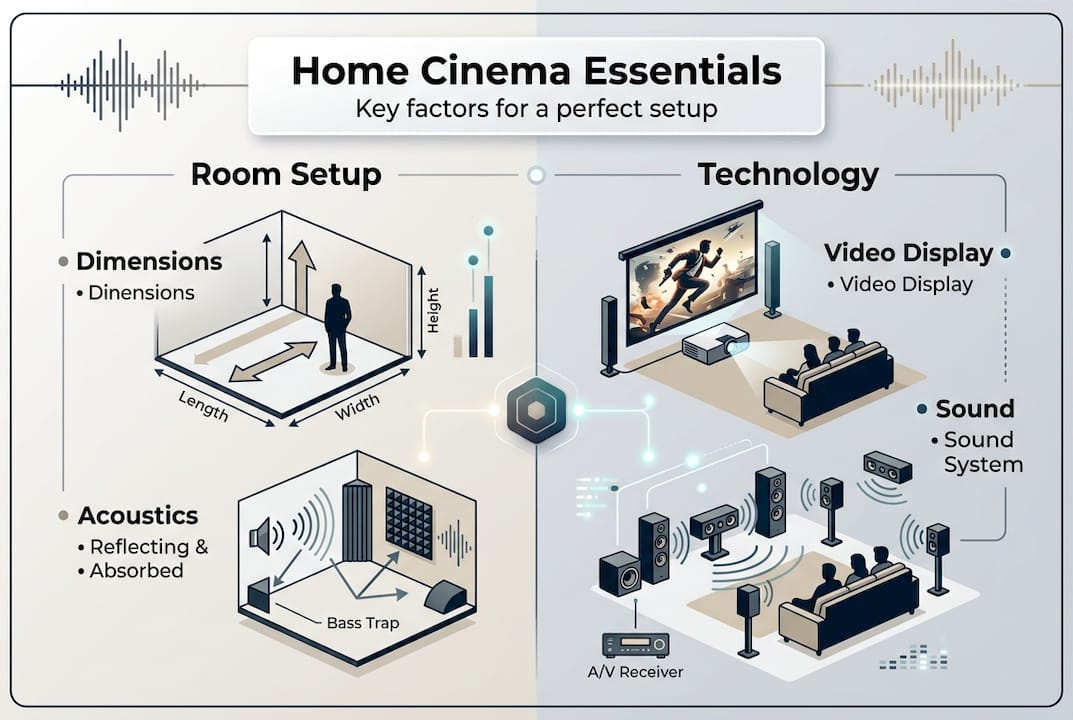
A home cinema is not a single product. It is a system, and every element within it affects the others. Getting the balance right across all components is what separates a genuinely immersive experience from an expensive disappointment.
The five core components to consider are:
- Audio: Surround sound systems, speaker placement, and acoustic treatment work together to create the sensation of being inside the content.
- Video: Screen size, display technology, and ambient light control determine picture quality and viewing comfort.
- Seating: Position, rake (the angle of tiered rows), and distance from the screen all affect how the experience feels.
- Control: Intuitive room control, whether through a dedicated system like Control4 or a simpler setup, makes the space easy to use for everyone.
- Environment: Acoustic panels, wall treatments, flooring, and ceiling height all shape how sound behaves in the room.
Room geometry is often underestimated. A room with parallel walls and a flat ceiling creates standing waves, where certain bass frequencies build up and cancel out, making dialogue muddy and music uneven. Addressing this early in the design process is far simpler than retrofitting solutions later.
For sound quality, the key measurement is RT60, which refers to reverberation time. It describes how long it takes for sound to decay by 60 decibels after a source stops. For a home cinema, you want this figure between 0.3 and 0.6 seconds. Below that, the room feels uncomfortably dead. Above it, sound becomes blurred and fatiguing.
“A well-designed cinema room is not about filling a space with equipment. It is about shaping the space so the equipment can perform as intended.”
According to benchmarks for bespoke cinema builds, investment typically ranges from $20,000 to over $200,000, with an ideal room size around 20×15 feet, screens between 100 and 150 inches, and a viewing distance of 1.0 to 1.2 times the screen width. These figures give you a useful framework when planning your space.
Pro Tip: Before specifying any equipment, map out how you intend to use the room. A space used primarily for films calls for different decisions than one used equally for gaming, sport, and music. Explore design-led cinema concepts to see how purpose shapes design, and read more about creating a tailored experience for your household.
Architectural considerations: Designing for your space
With the essentials in mind, the next step is harnessing your property’s architecture to optimise acoustics, comfort, and visual impact.
Room dimensions are not simply a matter of fitting enough seats. They directly influence how sound behaves, how large a screen feels comfortable, and whether tiered seating is practical. The table below outlines recommended configurations based on room size.

| Room type | Dimensions (approx.) | Rows | Notes |
|---|---|---|---|
| Media room | 10 x 12 x 8 ft | 1 | Casual viewing, single screen wall |
| Mid-size cinema | 12 x 18 x 9 ft | 2 | Sweet spot for most homes, good RT60 control |
| Dedicated theatre | 16 x 24 x 10+ ft | 2-3 | Multi-subwoofer setup, full acoustic treatment |
Ceiling height matters more than many homeowners expect. A higher ceiling allows for overhead speakers, which are essential for Dolby Atmos, a surround sound format that places sound in three dimensions rather than just around you. It also gives acoustic treatment more surface area to work with, improving RT60 performance across the room.
Existing architectural features can be genuine assets. Solid masonry walls provide natural sound isolation, reducing the need for additional construction. Alcoves and recesses can house equipment cleanly, keeping the room visually calm. Structural columns, where present, can anchor speaker positions without visible cabling.
Key architectural factors to address during planning:
- Wall construction: Solid walls reduce sound transmission to adjacent rooms.
- Floor type: Floating floors or carpet reduce low-frequency resonance.
- Door seals: Acoustic door seals prevent sound leakage without altering the room’s appearance.
- HVAC noise: Heating and ventilation systems must be considered, as fan noise can undermine a quiet scene.
Pro Tip: If your property is under renovation or extension, this is the ideal moment to discuss cinema integration with your architect. Structural changes made at this stage cost a fraction of what they would in a finished room. See how architectural impact shapes the result, and explore what integrated home cinema looks like when designed from the outset.
Choosing the right video solution: Projector or TV?
Designing the physical space naturally leads to choosing how you will display content. Should you opt for the grandeur of a projector or the versatility of a TV? The answer depends on your room, your habits, and how the space will be used day to day.
| Factor | Projector | OLED TV |
|---|---|---|
| Screen size | 100 to 150+ inches | Typically up to 97 inches |
| Ambient light | Requires a dark room or ALR screen | Performs well in brighter rooms |
| Black levels | Good with laser projectors | Outstanding, true blacks |
| Installation | Ceiling mount, hidden lens | Wall-mounted, simpler install |
| Longevity | Lamp or laser dependent | 20,000+ hours typical |
For a dedicated, light-controlled cinema room, a projector is almost always the right choice. Screens of 120 inches or more create a sense of scale that no flat panel can replicate. However, projectors lose performance in rooms with ambient light unless you use an ALR (ambient light rejecting) screen, which is a specialist surface designed to reflect projected light towards the viewer while absorbing light from other directions.
OLED televisions, on the other hand, produce genuinely exceptional picture quality. Their ability to turn individual pixels completely off delivers true blacks and outstanding contrast, making them ideal for rooms that serve multiple purposes throughout the day.
Considerations when choosing your display:
- Room usage: A room used only for cinema favours a projector. A room that doubles as a living space may benefit from a large OLED.
- Viewing distance: Sitting too close to a very large screen causes eye fatigue. A distance of 1.0 to 1.2 times the screen width is the accepted guide.
- Lighting control: Whatever display you choose, lighting in home cinemas plays a central role in perceived picture quality.
For architect-designed homes with dedicated cinema rooms, we often find that a laser projector paired with a motorised ALR screen offers the most considered result. It disappears when not in use and delivers a genuinely cinematic image when it does. Read more about smart home cinema systems to understand how display choice integrates with the wider system.
Audio, lighting and integration: Bringing your cinema to life
Once your screen and seating are mapped out, the atmosphere is what transforms a well-equipped room into a genuinely absorbing experience. Audio, lighting, and control are the three layers that bring everything together.
A considered surround sound layout follows a clear sequence:
- Front stage: Left, centre, and right speakers form the primary dialogue and action layer. Their placement relative to the screen is critical for sound localisation.
- Surround speakers: Side and rear channels create the sense of space around you. Height matters here; speakers positioned too low lose their effect.
- Overhead speakers: For Dolby Atmos, ceiling-mounted or in-ceiling speakers add the vertical dimension, placing rain, aircraft, and environmental sounds above you.
- Subwoofers: Low-frequency energy is felt as much as heard. Placement affects how evenly bass distributes across seating positions.
- Acoustic treatment: Panels, diffusers, and bass traps are not optional extras. They are what allow the speakers to perform as designed.
Lighting design is equally important and often overlooked. A layered approach, with adjustable scenes for cinema mode, interval lighting, and ambient use, means the room works beautifully across every occasion. Lighting that dims gradually as content begins, and lifts softly during pauses, makes the space feel considered rather than functional.
Automation ties everything together. Systems such as Control4 or Crestron allow audio, video, lighting, and climate to respond as a single environment. One press begins the experience: lights dim, the screen descends, the projector warms, and the sound system activates. For architect-designed homes, this kind of integration can be achieved invisibly, with lighting control in home cinemas and AV equipment housed within the fabric of the building.
Pro Tip: Plan all cabling routes, control positions, and equipment access points before any walls are closed. Retrofitting cable runs through finished walls is costly and disruptive. Explore cinema room lighting types to understand how each layer contributes to the finished result.
As noted in guidance for architect-designed properties, leveraging existing structure for isolation and tiering, and integrating AV into the architecture invisibly, produces the most coherent and lasting result.
Why real home cinema success requires collaboration from day one
In our experience, the most disappointing home cinema outcomes share a common cause. The AV system was planned after the building work was complete. Walls were already closed, cable routes were compromised, and the room’s acoustic properties were fixed before anyone had considered how sound would behave within them.
The most successful projects we have been involved in began with a conversation between the homeowner, the architect, and the AV specialist at the earliest possible stage. Not because the technology is complicated, but because the decisions are interconnected. A ceiling height chosen for visual proportion also determines whether Dolby Atmos is achievable. A wall finish selected for aesthetics also affects reverberation.
True integration, the kind that feels native to the home rather than added to it, requires this kind of joined-up thinking. It is not about compromise. It is about making each decision with full awareness of its effect on the others. Design-led cinema concepts show what becomes possible when the process is collaborative from the outset.
The homeowners who are most satisfied with their cinema rooms are rarely those who spent the most. They are those who planned the most carefully.
Elevate your home with expert automation and design support
If this guide has helped clarify what a bespoke home cinema involves, the natural next step is a conversation about your specific property and how it could be designed to work beautifully within it.

At Morgan Wrona, we work with homeowners and their architects to design integrated home cinema systems that feel entirely native to the spaces they inhabit. From initial concept through to commissioning and aftercare, every stage is managed with care. Whether you are at the planning stage or refining an existing space, explore how home cinema automation and home automation for architect-designed homes can work together in your property. To discuss your project, contact us or call [01793 315930](tel:01793 315930).
Frequently asked questions
What is the ideal room size for a home cinema?
A room of around 20×15 feet is considered the benchmark for a high-quality home cinema, offering enough space for proper speaker placement, tiered seating, and a screen of 100 inches or more.
Should I select a projector or a TV for my home cinema?
For a dedicated, dark room with a screen over 120 inches, a projector is the stronger choice. For brighter, multi-use spaces, an OLED TV delivers superior contrast and convenience at screen sizes up to around 97 inches.
How much should I budget for a bespoke home cinema?
A well-specified bespoke cinema typically begins around $20,000, with more involved builds reaching $200,000 or beyond depending on room size, acoustic treatment, display technology, and the level of automation required.
How can I hide speakers and AV equipment in a modern home cinema?
Collaborating with your architect from the outset allows speakers and equipment to be integrated invisibly within the structure, preserving both the room’s aesthetic and its acoustic performance.
What is the recommended reverberation time (RT60) for home cinemas?
Aiming for an RT60 of 0.3 to 0.6 seconds ensures sound is clear and accurate without feeling either too reverberant or unnaturally dry.