Replacing equivalent halogen bulbs with LEDs can reduce lighting electricity use by around 80% while maintaining comparable light output. Yet many homeowners with architect-designed properties struggle to balance sustainability with the refined visual quality their spaces demand. This guide addresses that challenge, showing you how to integrate energy-efficient lighting that enhances daily living, preserves architectural intent, and delivers measurable environmental benefits. You’ll discover practical approaches to selecting technologies, combining natural and artificial light, and implementing systems that adapt to how you actually use your home.
Table of Contents
- Understanding Sustainable Lighting
- Energy Efficiency In Sustainable Lighting
- Enhancing Daily Living Through Lighting Design
- Balancing Natural And Artificial Light
- Common Misconceptions About Sustainable Lighting
- Practical Implementation And Case Studies
- Cost Considerations And Long-Term Value
- Explore Sustainable Lighting Solutions With Morgan Wrona
- Frequently Asked Questions
Key takeaways
| Point | Details |
|---|---|
| Energy savings | Equivalent LEDs use around 80% less electricity than halogen bulbs; additional savings from smart controls vary by property and usage. |
| Design integration | Sustainable lighting enhances architect-designed homes without sacrificing aesthetic quality or ambience. |
| Daylight optimisation | A Berkeley Lab meta-analysis found average lighting-energy savings of 28% from daylighting controls in commercial buildings; results in individual homes will vary |
| Technology selection | Not all LEDs offer equal sustainability; lifecycle, materials, and certifications matter significantly. |
| Proven results | Measured outcomes. Results depend on the property’s existing lighting load, occupancy, daylight availability and how the controls are commissioned. |
Understanding sustainable lighting
Good sustainable lighting balances human needs and architectural integration with energy and environmental considerations. For architect-designed UK homes, this means solutions that reduce consumption while preserving the visual character and spatial quality your design demands. It’s not simply about replacing bulbs.
Sustainability in this context addresses three priorities. First, minimising energy use through efficient technologies and intelligent controls. Second, selecting products with responsible manufacturing and extended lifespans to reduce waste. Third, ensuring lighting quality supports wellbeing and complements architectural features rather than compromising them.
Why does this matter for larger, bespoke properties? Your home likely features considered spatial planning, material choices, and design details that standard lighting approaches can undermine. Sustainable lighting done well:
- Respects architectural intent while reducing environmental impact
- Delivers meaningful cost savings proportional to your home’s scale
- Enhances comfort and functionality across diverse spaces
- Maintains or improves property value through forward-thinking infrastructure
The challenge lies in balancing these factors without accepting compromises that diminish your home’s character.
Energy efficiency in sustainable lighting
The Energy Saving Trust says LED bulbs can use around 80% less electricity than equivalent halogen bulbs and can last up to 20 times longer, but understanding how different technologies compare helps you make informed choices. Halogens consume significant power and require frequent replacement. CFLs offer moderate efficiency but contain mercury and lack the controllability modern homes benefit from. Quality LEDs combine minimal energy use with lifespans exceeding 25,000 hours.
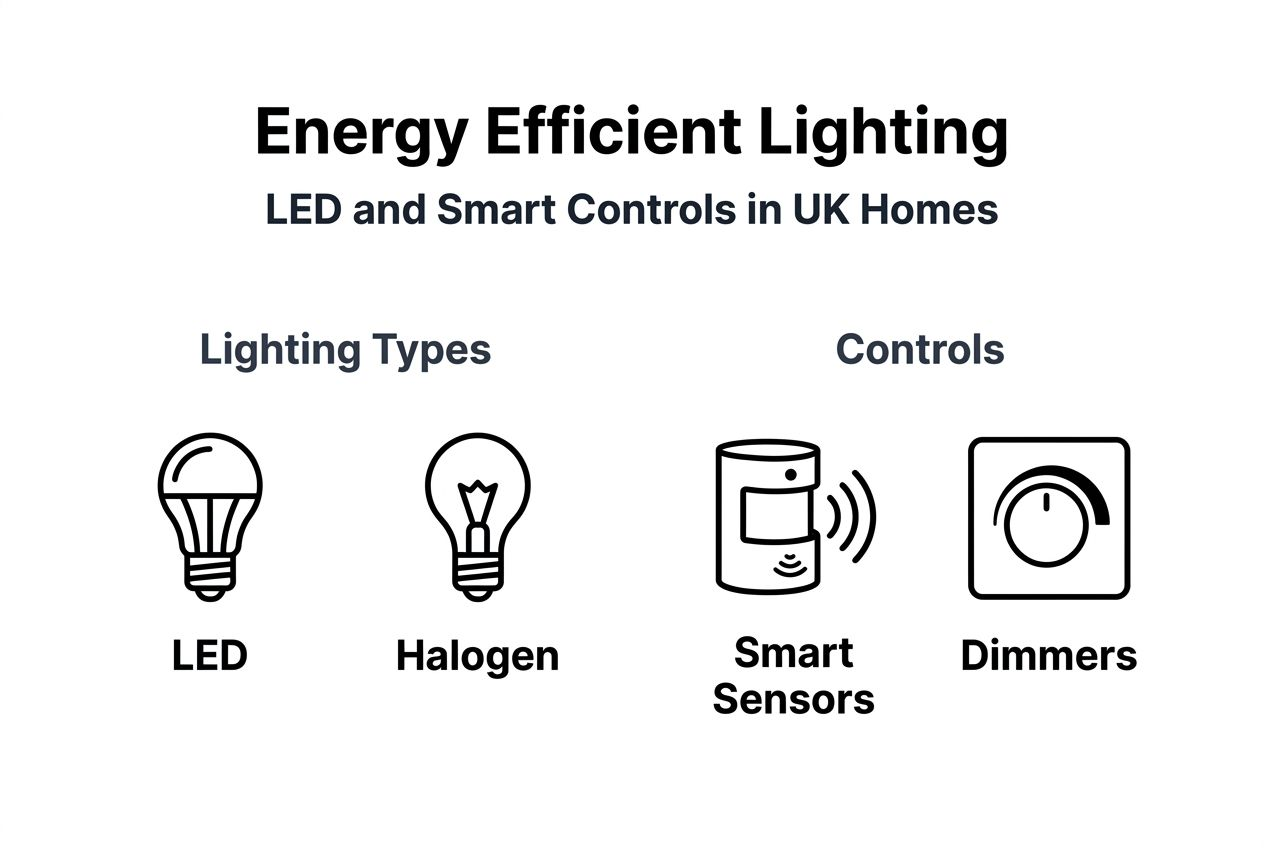
Smart lighting controls amplify these savings. A Berkeley Lab meta-analysis of 240 estimates found average lighting-energy savings of 24% from occupancy controls, 28% from daylighting controls and 38% from combined approaches in commercial buildings. For architect-designed homes with multiple zones and varied use patterns, this intelligence prevents unnecessary consumption without requiring constant manual adjustment.
Consider typical scenarios. A retrofit replacing halogen downlights with dimmable LEDs and occupancy sensors in circulation spaces can halve lighting energy use in those areas. Over a year, this translates to hundreds of pounds in reduced electricity costs for a larger home. Multiply that across a well-designed whole-home approach, and the financial case becomes compelling.
| Technology | Energy use (vs baseline) | Typical lifespan | Control compatibility | Colour quality |
|---|---|---|---|---|
| Incandescent | 100% | 1,000 hours | Limited | Excellent |
| Halogen | 70-80% | 2,000 hours | Moderate | Excellent |
| CFL | 25-30% | 8,000 hours | Poor | Variable |
| Quality LED | 15-25% | 25,000+ hours | Excellent | Excellent |
Pro Tip: Invest in certified LED products from established manufacturers. Cheaper alternatives often fail early, deliver poor colour rendering, or prove incompatible with dimming systems. The initial cost difference becomes negligible when you factor in energy-efficient smart lighting performance over years of use.
The lighting control benefits extend beyond energy savings to encompass convenience and adaptability as your household’s needs evolve.
Enhancing daily living through lighting design
Energy efficiency alone doesn’t make lighting successful. How light affects your daily experience matters equally. Dimmable, tunable white LEDs allow you to adjust both intensity and colour temperature throughout the day. Cooler light in the morning supports alertness. Warmer tones in the evening promote relaxation.
CIE says good integrative lighting should balance wellbeing, health and functioning with energy, environmental and architectural considerations; it recommends higher daytime light and much lower light before bed for healthy adults. This isn’t abstract theory. You notice the difference when your kitchen provides task-appropriate brightness for meal preparation, then shifts to a softer ambience for dining. Your bedroom lighting gently transitions as you wind down, supporting better sleep.
Integration with architectural design determines whether sustainable lighting enhances or undermines your spaces. Architectural lighting benefits become apparent when fixtures are selected and positioned to highlight materials, define volumes, and support how you use each area. A well-lit reading corner, properly illuminated artwork, or subtle accent lighting that reveals architectural detail all demonstrate this principle.
Smart controls make these scenarios accessible without complexity. You create scenes that recall preferred settings with a single touch or voice command. Lighting control to enhance ambience becomes intuitive rather than technical.
Practical applications include:
- Automated morning routines that gradually increase light levels to ease waking
- Activity-based presets for cooking, entertaining, or relaxing in open-plan spaces
- Presence detection that provides safe navigation lighting without leaving circuits on unnecessarily
- Integration with blinds to balance natural and artificial light seamlessly
Pro Tip: When specifying tunable white LEDs, verify the colour temperature range suits your spaces. Many products offer 2700K to 5000K, which covers warm relaxation tones through to cooler task lighting. Understanding lighting design principles helps you match technology to your home’s specific needs.
Balancing natural and artificial light
In a Berkeley Lab meta-analysis of commercial buildings, daylighting controls averaged 28% lighting-energy savings; actual performance varies and should be modelled for the building. For architect-designed homes, this often starts with the building’s orientation, window placement, and use of glazing. Your lighting strategy should build on these existing assets.

Daylighting reduces energy consumption most effectively when paired with responsive controls. Light sensors measure ambient conditions and dim or switch off artificial sources when natural light provides adequate illumination. This happens automatically, maintaining consistent light levels regardless of time of day or weather conditions.
Architectural features that support this approach include roof lights, clerestory windows, and carefully positioned glazing that brings daylight deep into floor plans. The challenge lies in managing glare and heat gain without resorting to heavy window treatments that negate daylighting benefits. External shading, carefully specified glass, and strategic placement of work surfaces relative to windows all play roles.
Practical implementation follows several steps:
- Assess existing daylight availability across different times and seasons in each space
- Identify zones where daylight can substantially reduce artificial lighting requirements
- Install photocell sensors in appropriate locations to measure ambient light accurately
- Configure lighting controls to respond proportionally, dimming electric sources as daylight increases
- Balance this with blinds or shading that address glare without completely blocking natural light
- Review and adjust sensor positioning and threshold settings based on actual use patterns
For retrofits, the most accessible opportunities often lie in spaces with good existing fenestration but no daylight-responsive controls. Adding sensors and linking them to dimmable LED circuits delivers immediate benefits without structural changes.
Common misconceptions about sustainable lighting
Several persistent misunderstandings create hesitation or poor decisions when homeowners consider sustainable lighting. Addressing these directly helps you avoid common pitfalls.
CIBSE TM66 says lighting sustainability should assess the full product lifecycle, including energy and resource inputs, materials, replaceability and end-of-life impacts. Not all LEDs are created equal. Products from reputable manufacturers using responsible sourcing and recyclable materials differ substantially from cheap alternatives with short lifespans and questionable supply chains. Sustainability requires considering the full lifecycle, not just operational efficiency.
Some believe sustainable lighting limits aesthetic options. This reflects outdated assumptions. Modern LED technology offers excellent colour rendering, precise beam control, and form factors from miniature downlights to decorative statement pieces. The constraint isn’t aesthetic, it’s ensuring your specification partner understands both design requirements and technical performance.
Another common concern suggests smart lighting systems introduce complexity that outweighs benefits. Well-designed systems are intuitive. You interact through familiar interfaces: switches that look conventional but recall scenes, smartphone apps for detailed control when wanted, voice commands for convenience. The sophistication operates invisibly, supporting rather than complicating daily use.
Some dismiss daylight integration as marginal. The data shows otherwise. Properly designed daylighting strategies deliver substantial reductions in electric lighting demand. The key lies in responsive controls that actually adjust artificial sources based on available natural light, rather than leaving that adjustment to manual intervention that rarely happens consistently.
Key points to remember:
- LED quality varies dramatically; certifications and manufacturer reputation matter
- Sustainable lighting encompasses energy, materials, lifespan, and indoor environmental quality
- Modern systems prioritise user experience; complexity is hidden from daily interaction
- Daylight integration offers significant energy savings when properly implemented with controls
Practical implementation and case studies
Translating principles into results requires a structured approach. Whether you’re building new or retrofitting an existing architect-designed home, the process follows similar steps with appropriate adaptations.
Implementation typically proceeds through these stages:
- Audit current lighting, documenting energy use, lamp types, control methods, and identifying issues or opportunities
- Define requirements for each space considering activities, architectural features, and desired ambience
- Design a lighting scheme that addresses these requirements using sustainable technologies and appropriate controls
- Select specific products based on performance data, compatibility, lifecycle considerations, and aesthetic fit
- Install with attention to positioning, aiming, commissioning of controls, and integration with other systems
- Commission thoroughly, creating scenes, setting sensor parameters, and verifying operation across scenarios
- Provide clear guidance on use and establish maintenance protocols to sustain performance
A recent UK case study illustrates these benefits. A five-bedroom architect-designed home in the Cotswolds replaced halogen and incandescent lighting throughout with tunable white LEDs and a comprehensive control system. The installation included daylight sensors in primary living spaces and occupancy detection in circulation areas.
| Metric | Before retrofit | After retrofit | Improvement |
|---|---|---|---|
| Annual lighting energy use | 3,240 kWh | 1,134 kWh | 65% reduction |
| Annual lighting cost (at £0.28/kWh) | £907 | £317 | £590 saved |
| Lamp replacement frequency | Every 12-18 months | Every 8-10 years | 85% reduction |
| Control flexibility | Manual switches only | Scenes, scheduling, automation | Substantial improvement |
The homeowners reported improved comfort from tunable lighting, simplified control through scenes, and satisfaction from reduced environmental impact. The UK Energy Technology List says savings of 30–50% are common where appropriate automatic controls are used, depending on the space and control strategy.
Professional consultation ensures your lighting strategy aligns design intent, technology selection, and sustainability goals. The lighting workflow guide provides a framework for thinking through these considerations systematically.
Pro Tip: Plan for future adaptability. Your needs will evolve. Systems that allow scene editing, fixture additions, and integration with emerging technologies protect your investment. Understanding lighting automation benefits helps frame decisions that remain valuable long-term.
The smart lighting impact extends beyond energy metrics to encompass how your home supports daily life.
Cost considerations and long-term value
Sustainable lighting requires upfront investment. Understanding costs, payback periods, and long-term value helps you evaluate options confidently.
Project costs and payback periods vary materially according to property size, circuit count, fixture specification, control requirements and installation complexity. A project-specific survey, design and energy model are required before reliable costs or savings can be estimated.
Energy Saving Trust field trials found LED products typically lasted two to five times longer than the fittings they replaced, reducing lamp-replacement and maintenance time. You’re not replacing lamps annually or dealing with frequent failures. For homes with high ceilings or difficult access, this maintenance reduction represents genuine value beyond the cost of lamps themselves.
Long-term value emerges from several sources:
- Ongoing energy cost savings that compound over decades
- Reduced maintenance labour and disruption
- Enhanced comfort and wellbeing from better lighting quality
- Increased property appeal through modern, sustainable infrastructure
- Future-proofed systems that adapt as needs change
Financial analysis shouldn’t ignore these less tangible benefits. The difference in how your home feels with properly designed lighting affects daily life far more than the initial cost suggests. The ability to adjust ambience effortlessly, the reduced eye strain from appropriate illumination, the satisfaction of measurably lower environmental impact—these contribute to your home’s value in ways that extend beyond simple payback calculations.
For many homeowners, the decision isn’t whether sustainable lighting makes financial sense, but rather ensuring the specific approach chosen delivers maximum benefit for the investment required. This comes back to thoughtful design, quality products, and professional implementation.
Explore sustainable lighting solutions with Morgan Wrona
Your architect-designed home deserves lighting that enhances its character while supporting how you live. Morgan Wrona specialises in creating lighting automation solutions tailored to bespoke properties where design sensitivity and technical performance both matter.

Our approach integrates sustainable technologies with architectural intent. We design systems that adapt to your routines, respond to natural light, and provide the control flexibility your home requires. Whether you’re planning a new build or considering a retrofit, we work collaboratively to understand your spaces and create lighting workflow design guide solutions that deliver lasting value.
Explore how thoughtful lighting design principles can transform your home. If you would like to discuss your specific requirements, call 01793 315930 or download our brochure.
Frequently asked questions
What makes lighting sustainable for architect-designed homes?
Sustainable lighting balances energy efficiency with architectural and aesthetic integration. It considers the full lifecycle of products, from manufacturing through disposal, whilst preserving design intent. For bespoke homes, this means solutions tailored to specific spaces and use patterns rather than generic approaches.
How do smart lighting controls improve energy efficiency without complexity?
Smart systems automate lighting based on occupancy, daylight availability, and time schedules. This happens invisibly, preventing waste without requiring constant manual adjustment. User interfaces remain intuitive through familiar switches, smartphone apps, or voice commands. The role of lighting control centres on making sophisticated behaviour simple in daily use.
Can natural daylight significantly reduce artificial lighting needs in my home?
Yes. A Berkeley Lab meta-analysis found average lighting-energy savings of 28% from daylighting controls in commercial buildings; performance in individual homes varies and should be modelled for the property. This requires responsive controls that actually dim or switch off artificial sources as natural light increases. Architectural design plays a crucial role through window placement, glazing selection, and shading strategies that maximise useful daylight whilst managing glare.
What should I consider when selecting sustainable LED lighting products?
Look for verified certifications, published lifecycle data, and products from established manufacturers with transparent supply chains. Choose dimmable, tunable white LEDs compatible with quality control systems. Verify colour rendering index exceeds 90 for spaces where colour accuracy matters. Consider the full fixture assembly, not just the lamp, to ensure longevity and performance match your expectations.