When your architect mentions beam angles or your home lighting designer discusses colour temperature, do you find yourself nodding along whilst secretly uncertain what these terms actually mean? You’re not alone. Many homeowners with architecturally designed properties struggle with specialised lighting terminology, making it difficult to confidently participate in design discussions or evaluate proposals. Understanding these terms transforms your ability to shape your home’s lighting environment and ensures your vision is accurately realised.
Table of Contents
- Key takeaways
- Understanding foundational home lighting terms
- Key technical lighting terms and their architectural importance
- Comparing lighting fixture types and their suitable applications
- Sustainable and energy-saving lighting terms every homeowner should know
- Explore professional lighting solutions for architect homes
- Frequently asked questions
Key Takeaways
| Point | Details |
|---|---|
| Foundational lighting layers | Ambient, task and accent lighting form the three foundational layers that shape a room’s function and mood. |
| Fixture types explained | Downlights, pendants, wall sconces and chandeliers each serve distinct purposes within a home’s lighting scheme. |
| Key measurements explained | Lumens measure total light output, lux measures illumination on a surface, watts indicate energy consumption, and CRI shows how accurately colours render. |
| Beam and temperature guidance | Beam angle determines how light spreads from a fixture and affects how spaces feel, while colour temperature sets the atmosphere from warm to cool. |
Understanding foundational home lighting terms
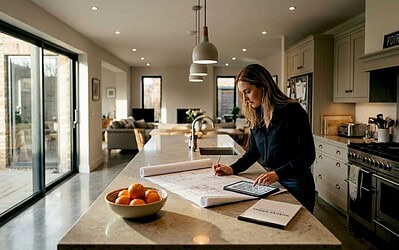
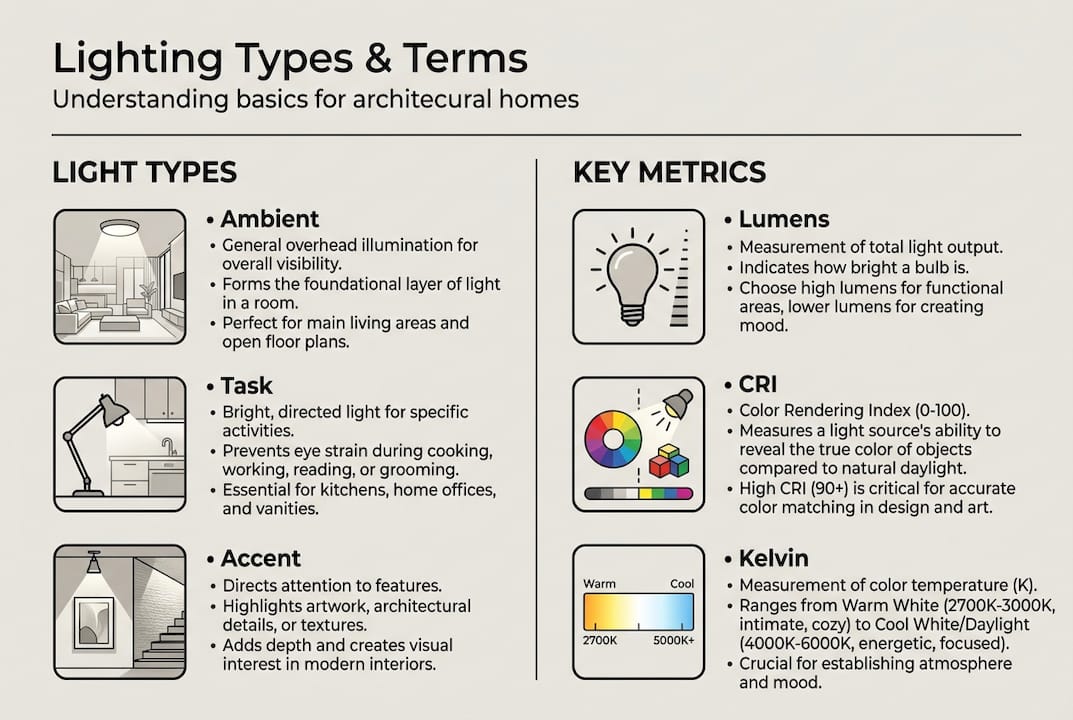
Every conversation about architectural lighting begins with three fundamental concepts: ambient, task, and accent lighting. These layers work together to create functional, comfortable spaces. Ambient lighting provides overall illumination for a room, allowing you to move safely and see clearly. Task lighting focuses on specific activities like reading, cooking, or working at a desk. Accent lighting highlights architectural features, artwork, or design elements you want to emphasise.
Fixture types form the vocabulary of home lighting design. Downlights, recessed into ceilings, offer clean lines that suit contemporary architecture. Pendants hang from the ceiling, providing both illumination and visual interest above dining tables or kitchen islands. Wall sconces attach to vertical surfaces, creating layers of light at eye level. Chandeliers serve as focal points whilst distributing light across larger spaces. Each fixture type serves different purposes within your home’s lighting scheme.
Technical measurements help you evaluate home lighting performance objectively:
- Lumens measure the total light output from a source, indicating brightness
- Lux describes how much light falls on a surface, showing illumination intensity
- Watts indicate energy consumption, not brightness as many assume
- CRI (Colour Rendering Index) reveals how accurately colours appear under a light source
Understanding these terms matters because they shape every lighting decision in your home. When you know that a 3000K colour temperature creates warmth whilst 5000K feels clinical, you can specify exactly the atmosphere you want. When you grasp that 800 lumens might suit a bedroom but a kitchen needs 3000 lumens, you avoid spaces that feel too dim or glaringly bright. This knowledge transforms abstract design conversations into concrete, achievable outcomes.
Pro Tip: Create a simple glossary of terms as you encounter them during your project. Note definitions alongside examples from your own home to build confidence in using technical language naturally.
Key technical home lighting terms and their architectural importance
Beam angle determines how light spreads from a fixture, fundamentally affecting how spaces feel. A narrow 25-degree beam creates focused pools of light, ideal for highlighting artwork or architectural details. A wide 60-degree beam distributes illumination broadly, suitable for ambient lighting. Understanding beam angles helps you predict how light will interact with your rooms’ proportions and surfaces.
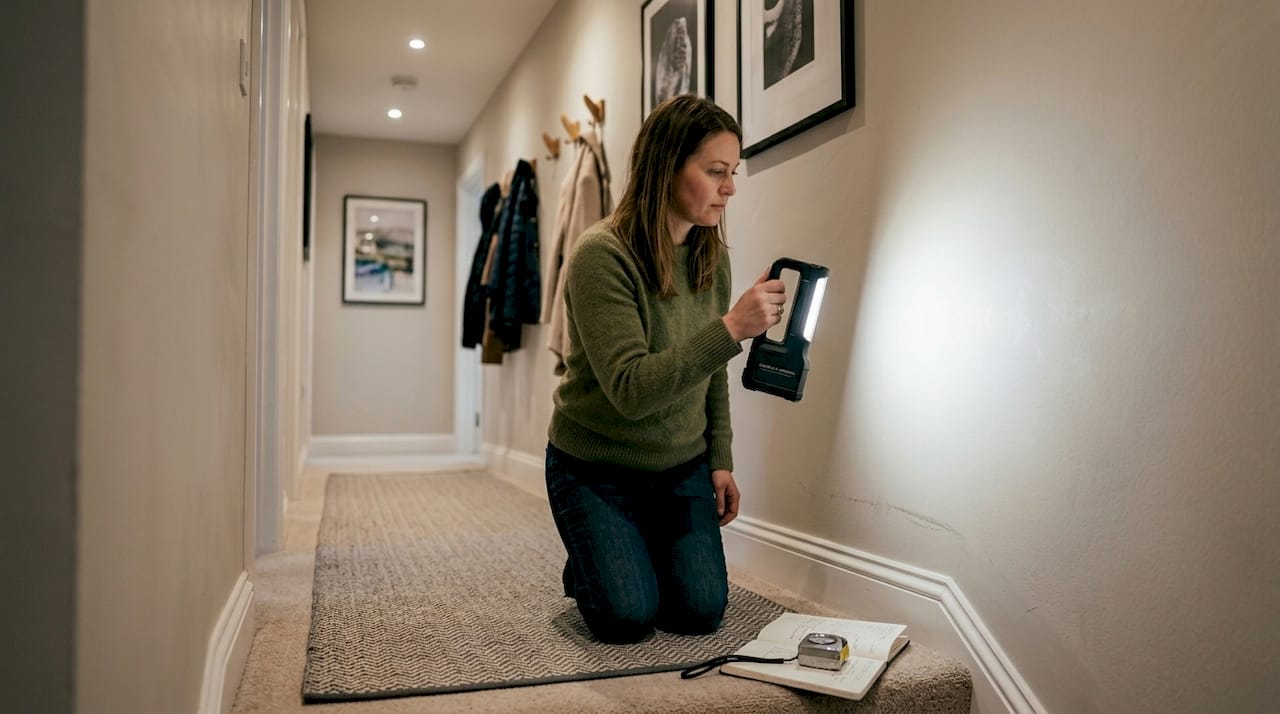
Colour temperature, measured in Kelvin, profoundly influences atmosphere. Lower values around 2700K produce warm, amber tones that feel intimate and relaxing, perfect for living spaces and bedrooms. Mid-range 3000K to 4000K offers neutral white light suitable for kitchens and bathrooms. Higher values above 5000K create cool, blue-toned light that feels energising but can appear harsh in residential settings. Selecting appropriate colour temperatures for each space ensures your home feels cohesive and intentional.
Lumens and CRI work together to define home lighting quality. Whilst lumens tell you how much light you receive, CRI reveals how faithfully that light renders colours. A CRI above 90 shows colours accurately, essential in spaces where you appreciate art, select clothing, or prepare food. Lower CRI values can make spaces feel flat and colours appear distorted, regardless of brightness levels.
Dimmability and integration with lighting control systems represent advanced capabilities increasingly expected in architecturally designed homes. Dimmable fixtures allow you to adjust light levels throughout the day, matching natural light patterns and activities. Integration with control systems enables scenes that recall specific settings instantly. You might programme “morning” to gradually increase light, “entertaining” to create ambient warmth, and “cinema” to dim living spaces appropriately.
These technical terms directly affect both ambience and energy consumption. A well-designed scheme using appropriate beam angles and colour temperatures creates the atmosphere you want whilst minimising wasted light. Smart lighting control systems that dim or switch off unused fixtures reduce energy costs without requiring conscious effort.
Pro Tip: Consult home lighting control specialists during your project’s early design phase. They can translate your lifestyle needs into technical specifications that work seamlessly with your home’s architecture.
Comparing home lighting fixture types and their suitable applications
Choosing appropriate fixtures requires understanding how different types perform in architectural contexts. Each option offers distinct advantages and limitations that affect both aesthetics and functionality.
| Fixture type | Best applications | Key advantages | Considerations |
|---|---|---|---|
| Recessed downlights | Kitchens, bathrooms, corridors | Clean aesthetic, space-saving, versatile | Requires ceiling depth, can create shadows |
| Pendant lights | Dining areas, kitchen islands | Visual interest, task lighting, defines zones | Needs appropriate ceiling height, visible cords |
| Wall sconces | Hallways, bedrooms, living rooms | Eye-level lighting, architectural accent | Installation requires wall preparation, wiring |
| Track lighting | Galleries, flexible spaces | Adjustable direction, easy reconfiguration | Industrial appearance may not suit all interiors |
| Chandeliers | Entrance halls, dining rooms | Statement piece, distributed light | Requires structural support, maintenance access |
When selecting fixtures for different rooms, consider these practical factors:
- Ceiling height influences pendant length and chandelier scale
- Room function determines required light levels and colour temperature
- Architectural style guides fixture design language and finish
- Maintenance access affects fixture complexity and lamp replacement frequency
- Integration with existing systems influences control capabilities
Layering different fixture types creates depth and flexibility in your home lighting scheme. You might combine recessed downlights for ambient illumination with pendants for task lighting and sconces for accent lighting. This approach, fundamental to sophisticated lighting design, allows you to adjust your environment for different activities and times of day.
Common pitfalls include choosing fixtures that overpower room proportions or selecting styles that conflict with architectural intent. A modern minimalist pendant looks incongruous in a period property, whilst an ornate chandelier feels wrong in a contemporary space. Overly bright fixtures create glare and discomfort, whilst insufficient light levels make spaces feel unwelcoming.
Understanding fixture types and their applications helps you evaluate proposals from designers and make informed decisions that serve both immediate needs and long-term satisfaction. The right fixtures become invisible parts of your daily life, providing exactly the light you need without drawing unwanted attention.
Pro Tip: Request samples or visit showrooms to see fixtures illuminated before specifying them. Photographs rarely capture how light actually appears in three-dimensional space.
Sustainable and energy-saving lighting terms every homeowner should know
Sustainability terminology helps you make environmentally responsible choices that also reduce operating costs. These concepts increasingly influence lighting decisions in thoughtfully designed homes.
- LED (Light Emitting Diode) technology represents the current standard for residential lighting. LEDs consume significantly less energy than incandescent or halogen alternatives whilst lasting 25,000 to 50,000 hours. They generate minimal heat, reducing cooling loads in summer. LED lighting cuts home energy use substantially whilst offering superior design flexibility through compact sizes and dimming capabilities.
- Lumens per watt measures lighting efficiency, showing how much light you receive for each unit of energy consumed. Higher values indicate more efficient fixtures. Modern LEDs typically achieve 80 to 100 lumens per watt, compared to 15 lumens per watt for traditional incandescent lamps. This metric helps you compare fixtures objectively rather than relying on wattage alone.
- Energy ratings provide standardised efficiency information. Look for fixtures with high energy ratings when specifying products. These ratings account for total energy consumption including control systems and standby power, giving you a complete picture of long-term costs.
- Lifespan indicates how long fixtures maintain acceptable performance before requiring replacement. LED fixtures rated for 50,000 hours can last over 15 years with typical residential use. Longer lifespans reduce maintenance requirements and replacement costs, particularly important for fixtures in hard-to-reach locations.
- Recycling and disposal matter because home lighting products contain materials requiring proper handling. LED fixtures contain electronic components that should be recycled through appropriate programmes. Understanding disposal requirements helps you plan for eventual replacement responsibly.
Smart lighting controls amplify sustainability benefits by ensuring lights operate only when needed. Occupancy sensors switch off lighting in unoccupied rooms. Daylight harvesting systems dim artificial light as natural light increases. Scheduling ensures lights align with your routines without manual intervention. These technologies reduce waste whilst maintaining comfort and convenience.
These terms matter for UK homeowners interested in responsible design because they connect environmental values with practical benefits. Sustainable lighting solutions reduce your carbon footprint whilst lowering energy bills and maintenance requirements. The initial investment in efficient fixtures and controls typically recovers within a few years through reduced operating costs.
External resources like sustainable lighting guides offer additional perspectives on implementing environmentally conscious lighting strategies. These complement manufacturer specifications and designer recommendations, helping you make fully informed decisions.
Explore professional lighting solutions for architect homes
Understanding home lighting terminology equips you to participate meaningfully in design conversations, but translating knowledge into reality requires specialist expertise. Professional lighting automation services bring together technical capability and design sensitivity, creating systems that enhance both comfort and architectural integrity.

Comprehensive workflow planning resources guide you through each project phase, from initial consultation through commissioning and aftercare. This structured approach ensures your home lighting scheme develops logically, with technical decisions supporting your design vision rather than constraining it. Smart lighting systems adapt to how you actually live, adjusting automatically throughout the day whilst remaining simple to control.
Working with specialists who understand both technology and architecture means your home’s lighting feels intentional and cohesive. Every fixture, control, and setting serves a clear purpose within the larger scheme. If you would like to discuss how professional lighting design could work in your home, contact us or call 01793 315930.
Frequently asked questions
What is the difference between ambient and task lighting?
Ambient lighting provides general illumination for entire rooms, allowing safe movement and basic visibility. Task lighting focuses on specific activities like reading or food preparation, delivering higher light levels exactly where needed. Understanding both concepts is essential for creating layered lighting schemes that serve multiple purposes within single spaces.
How does colour temperature affect home ambience?
Lower colour temperatures around 2700K to 3000K create warm, relaxing atmospheres suitable for living spaces and bedrooms. Higher temperatures above 4000K produce cooler, more energising light appropriate for functional areas. Choosing appropriate Kelvin values for each space helps you achieve the precise atmosphere you want whilst maintaining visual coherence throughout your home.
Why is understanding lighting terminology important for renovation projects?
Clear terminology facilitates productive conversations with architects, designers, and contractors, ensuring everyone shares the same understanding. It helps you evaluate proposals objectively, comparing fixtures and systems based on performance rather than marketing claims. This knowledge ensures your design intentions translate accurately into built reality. Refer to our lighting design checklist for homeowners for guidance on managing renovation lighting decisions.
What does CRI mean and why does it matter?
CRI (Colour Rendering Index) measures how accurately a light source reveals colours compared to natural daylight. Values above 90 show colours faithfully, essential in spaces where you appreciate art, select clothing, or prepare food. Lower CRI values can make spaces feel flat and colours appear distorted, regardless of brightness. Specifying appropriate CRI ensures your home’s materials and furnishings appear as intended.
How do smart lighting controls reduce energy consumption?
Smart controls automatically adjust lighting based on occupancy, daylight levels, and time of day, eliminating waste from lights left on unnecessarily. Dimming capabilities reduce power consumption when full brightness isn’t needed. Scheduling aligns lighting with your actual routines without requiring manual intervention. These features typically reduce lighting energy use substantially whilst maintaining comfort and convenience throughout your home.